Mana Inc is helping troubled youth turn their lives around
By MAS Team
By MAS Team
Last updated 25 May 2026
As a secondary teacher, Kelly Peterson-Teariki saw first hand the impact that kindness and compassion could have on troubled teens. She talks to Nicky Dewe about using her experience to empower youth beyond the classroom.
“It’s not rocket science, what we’re doing here,” says Kelly Peterson-Teariki, CEO and founder of a transformative organisation called Mana Inc. It’s a statement that belies the incredible impact her mahi is having, though it’s true that at its heart, the kaupapa of Mana Inc is quite simple: Passionate and committed people sharing their time, energy and skills with a group of taiohi (youth) who stand to benefit greatly from kindness, nurturing and investment.
Mana Inc has been a brave and beautiful mission of Kelly’s, built in the post-Covid period when crime and truancy were at an all-time high in her South Auckland neighbourhood of Papakura. As a trained secondary school teacher, a leader in education and an expert in pastoral care, Kelly had the mātauranga and the experience to recognise what was needed and took a bold step to try and turn the tide of this growing problem.
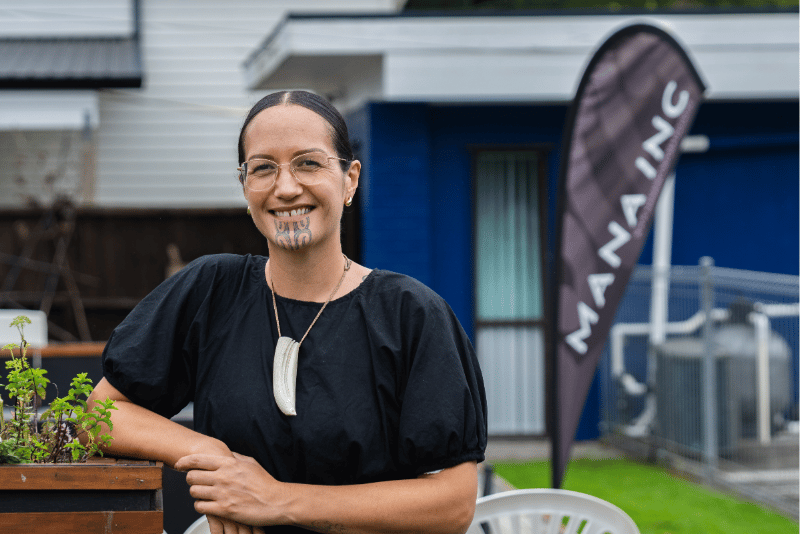
Many of the taiohi who come through the Mana Inc programme have faced serious challenges in their young lives, falling through the cracks of education and employment, and some are already caught up in the youth justice system.
“We’ve got kids that have been involved in really serious criminal activity prior to coming here,” explains Kelly. “So the first step is to sit them down and say, ‘Look, you need to own the parts of this that you’ve done, because you can’t move forward if you can’t accept that you’ve caused some harm.’”
Kelly says that once the kids face up to the gravity of their actions, they’ll often say to her, “Why do you still like me?” She’ll respond, “Because that was just one moment in time, but you were born as this beautiful baby with all this mana and potential and it’s still in there. It’s just been clouded, so we’re going to pull it back.”
It’s a critical point for reaching these taiohi, says Kelly, “because they’re in this period of time when they're still youthful. They’ve got their lives ahead of them and they’re going to be māmā and pāpā themselves sometime, so how do we want them to be in that role? Our job is to help them realise how awesome they are without all that other nonsense.”
The process of ‘pulling it back’ is to guide the taiohi through a learning and support programme built around the holistic health model of Te Whare Tapa Whā. The programme (which operates in 10 week cycles) sees participants get involved in a range of mana-enhancing activities. This includes: focusing on their hauora (health); practising creativity through sketching, crafting and
building; learning entrepreneurship; and participating in activities on the whenua (land) and moana (sea) like fishing.
“The hook for them is being outdoors, but they’re also learning about how to be a kaitiaki of our moana. They get to know what it actually feels like to gather kai and give it to someone else. Afterwards, they provide it to their own whānau or to those less fortunate, and through that they get to experience all that manaaki and how you feel good by using your physical self in a positive way.”
While these bigger missions have a massive impact, there are smaller moments that make a difference too. “I had a young boy say to me, ‘When I own my own house, and I have visitors, I'm going to do this too,’” says Kelly. “I asked him, ‘What do you mean?’ and he said, ‘I’m gonna give them a Milo and a biscuit, and talk like we’re doing.’ Up until now, that concept had been so foreign to him, because he hadn’t seen it. Now he’s starting to think, ‘This is how I’m going to treat people.’”
While the kaupapa of Mana Inc is clearly proving to be positive, the approach – bringing together groups of troubled teens – was novel and viewed by some as risky when it first began in 2021. Kelly’s own personal and professional life experiences, however, had shown that restoring identity and igniting passions were the key to breaking through.
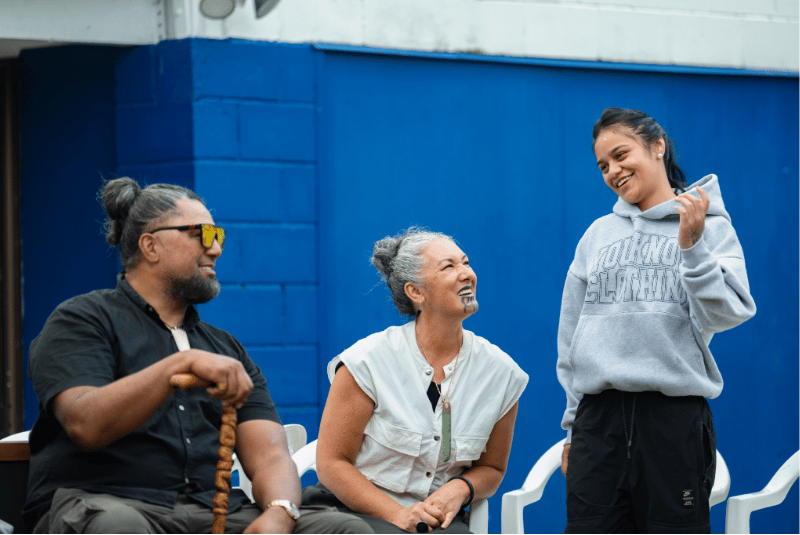
“I was born and raised down in Gore by a Pākehā mum and a Māori-Samoan dad, at a time when there weren’t many Māori families down there,” says Kelly. “Me and my 3 siblings had a beautiful upbringing. Mum had 2 jobs, Dad was in the meatworks and sport was our thing. We didn’t have all the flash stuff, but we had everything we needed.
“As an adult reflecting back though, there was always something missing – and that was identity. I’ve come to realise that the associations I had with my Māoritanga at that time were all the things I didn’t like. Growing up, anything to do with violence or alcoholism or abuse always seemed to come from whānau Māori.”
Kelly says her own life could have been marked by these same challenges, but as a good scholar with a determined streak, she made her way to the University of Otago to gain a degree in physical education, followed by a postgraduate qualification in secondary teaching. A principal who recognised her potential invited her to apply for a position at Auckland’s Aorere College, and at 21 years of age with a 1-year-old daughter, she called on her courage and moved north.
Within her first week at Aorere, Kelly’s eyes were opened to a new world. “There were all these Māori and Pasifika people doing beautiful things. Suddenly I could see, feel and hear this abundance of culture. And I was like, ‘Wow, what is this?’”
Over the next decade at Aorere, Kelly’s career flourished, as did the lives of her students. “In my second year there, I was kind of pushed into leadership because there were a lot of kids no one else would take, but who were doing really well in my class.
“I was just being kind, using affirmations and finding different ways to make learning exciting and fun. I got booklets translated into their languages, that sort of thing. I just thought, ‘Well, that’s what you should do, shouldn’t you?’ What it showed me was that if these kids are feeling good, they can achieve anything.”
In 2015, Kelly was shoulder-tapped to take on a leadership role at Papakura High School in the wake of a damning Education Review Office (ERO) report for the school. Again, she applied the same principles from her past experiences. “It really started not with the curriculum, but with the adults. Who are people in front of these kids day in and day out? Do they have a passion for it? Do they like kids? Over the next couple of years, we were stripping back the pastoral care system to make it better so the kids wanted to be there and were proud to show up.”
After Covid however, the numbers dropped. “When we started returning back to school, the number of kids that didn’t show up went through the roof. I just couldn’t turn away from it anymore.”
Knowing she couldn’t help them if they weren’t there, Kelly began working her other connections in the community and looking for what she could do.
“Prior to this, I had been in lots of multi-agency hui, and people were trying to do things, but there wasn’t really anything that was sticking because the same kids were reoffending.”
One of the kids who had recently been in trouble was known to Kelly through whānau at the school, so she decided to step in and do something. One morning, Kelly and her colleague at Mana Inc, Muna Lee, went and bought pies and bakery treats and turned up at a home they knew a group of taiohi were crashing at.
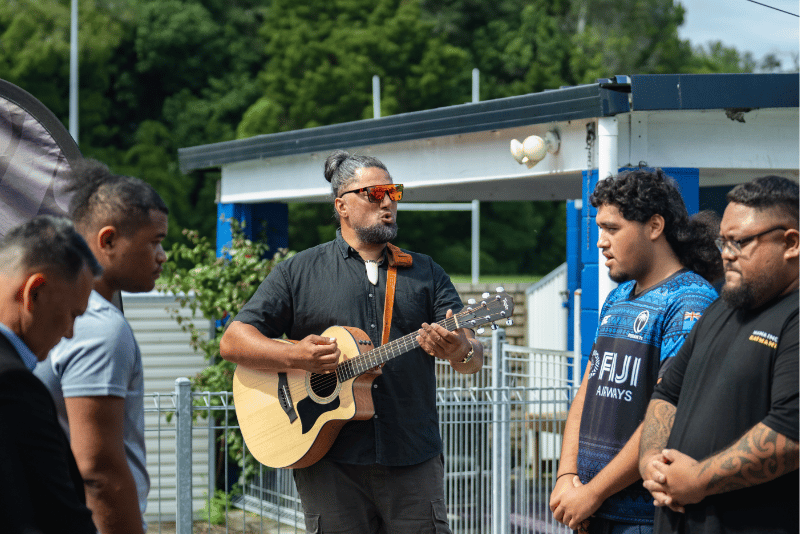
“We just talked to them like you’d talk to your own teenage child, around what they love, their aspirations, what they were like at school, just normal stuff. That kind of opened them up a little bit and then they started talking about what was not going so well.”
Homelessness and poverty featured in their stories, as well as family harm. Afterwards, Kelly wrote a proposal for what would become Te Rauora Taiohi – Youth Empowerment programme and shared it back to the boys who agreed to take part.
“I went to the police, to Ngāti Tamaoho, our hapu here, Papakura Marae, Oranga Tamariki and the local board. I said, ‘Right, we’re not mucking around here. These kids are giving us some answers, so let’s try this because I think it might work.”
Straight away they saw success with youth not reoffending, and they received funding from the Department of Internal Affairs to continue. Early in the programme, MAS Foundation stepped in with a grant that helped solidify Mana Inc’s future. “When I met with [Heads of Foundation] Julie and Mafi, we’d just started to establish ourselves. I shared what we were up to and it just aligned so well with MAS Foundation’s focus on improving the wellbeing of children.”
Kelly says that while some funds went straight to programme costs so they could keep running, a big part of it went to laying the foundations that would make Mana Inc sustainable for the future. This included establishing an HR system, getting the right legal support and looking into
becoming a charitable trust. “It was those important nuts and bolts that were not even in my frame of thinking at that time,” says Kelly. “I was more focused on the bottom of the cliff stuff, but they said to me, ‘We really see value in what you’re doing. We want to help you to build those foundations so that you actually can be around for a lot longer.’ They saw that before I did.”
Now, some 3 years later, Mana Inc has 10 kaimahi on the team and is still going strong. From the first group of boys whose lives turned around to the 160 other kids who have followed, the approach is working.
“The power of people just speaking good kōrero to these kids is like magic,” says Kelly. “We’re not doing anything out of this world; it’s just being kind and opening up their eyes to other things that they never knew existed.”
Dr Julie Wharewera-Mika (Head of Foundation) says, “Every taiohi is born with mana, when we choose to see it, speak to it and build around it, we don’t just change a young person’s trajectory, we restore the foundations of whānau and community. This kaupapa proves that when systems centre mana and whānau, they shift from managing problems to unlocking potential, becoming more responsive, more human, and ultimately more transformative for the generations to come.”
Mafi Funaki-Tahifote (Head of Foundation) adds, “Mana Inc’s commitment to ‘weaving people together’ and surrounding taiohi with ‘ofa/aroha, compassion and respect closely reflect MAS Foundation’s value of ‘whiria te tangata’. Together, these values help strengthen health and wellbeing equity for our future māmā and pāpā, especially those from communities facing the greatest challenges.”
Meet MAS Here for Good Scholarship recipient, Olivia Gray, who details her volunteer activity and the reward of giving the gift of time.
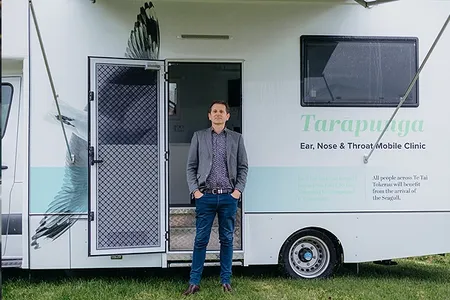
As a driving force for change in rural healthcare, the Tarāpunga mobile ENT clinic brings much-needed ear, nose and throat treatment to at-risk communities.

Member engagement and clarity of purpose were key factors in the journey to enable MAS to make a stronger contribution to the health of Aotearoa New Zealand.