Published 18 November 2026
The end of October and early November 2026 have seen increased volatility, as markets gave back some of this year's gains. Although the pullback was broad-based across the market, companies related to artificial intelligence (AI) were among the most affected — with the technology-heavy Nasdaq-100 Index falling 3.5% on the final trading day of October. Despite the recent volatility, the Nasdaq-100 Index remained around 11% higher for the year to 13 November, providing some context for the recent declines following a period of strong performance.
Market volatility can feel uncomfortable, but it is always a normal part of long-term investing and often accompanies the higher returns that shares are expected to provide over time.
Chart 1: Biggest gains and falls in the global stock market in each of the past 54 calendar years
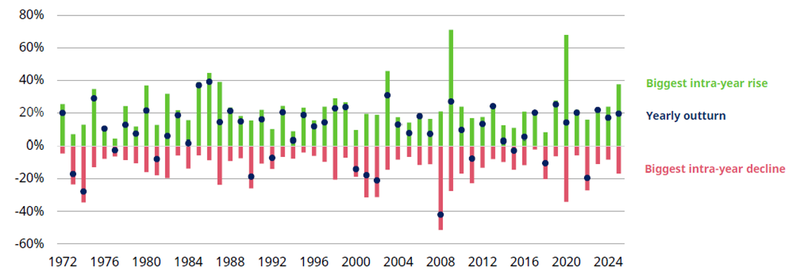
Source: LSEG Datastream, MSCI, and Schroders. Notes: Data 1972-2025. Returns are for the MSCI World price index in US dollar terms. Bars show the biggest peak-to-trough fall and trough-to-peak rise in the price index in each calendar year.
Over the last 54 years, global shares have experienced an average intra-year fall of around 15%. The average calendar-year return has mainly been positive despite these falls, with the average largest intra-year rise being around 23%. This is a useful reminder in times of volatility to step back from the short-term market noise and remain focused on your long-term investment goals.
What is causing the current volatility?
Recent volatility in AI-related shares appears to reflect a combination of factors occuring at the same time, rather than a fundamental change in the long-term outlook for AI. Together, these developments have encouraged investors to take a more cautious view for now.
AI-related companies have been an important driver of global share market returns over the past few years. Significant investment in data centres and other AI infrastructure has also supported US economic activity at a time when some other sectors have faced policy uncertainty and trade headwinds. However, the scale and speed of this investment have come under scrutiny, including the growing use of debt to fund new infrastructure. Volatility has increased as investors scrutinise the significant investments being made into AI infrastructure and question how quickly it will translate into higher profits. This does not necessarily reflect weaker confidence in AI's long-term potential, but rather a greater focus on whether the returns will justify the scale and pace of current spending.
The US midterm elections in early November added another source of uncertainty for the AI theme and contributed to market volatility. Some successful Democratic candidates supported greater oversight or temporary restrictions on new data centre developments, reflecting concerns about electricity costs, water use, and effects on local communities. It remains uncertain at this stage whether these proposals will lead to significant changes, but either outcome does not necessarily alter the longer-term demand outlook for AI. This could, however, extend development timelines for some companies benefitting from AI-related investment.
US inflation data from November 2026 was also higher than expected, adding to share market volatility and pressure on AI-related companies. Higher inflation may mean that the US Federal Reserve needs to keep interest rates higher for longer — or raise them further — to help bring inflation down. This is particularly relevant for companies heavily investing in AI infrastructure, as higher interest rates increase borrowing costs and can make large-scale investment more expensive.
Not all of the recent weakness in AI-related shares has reflected broader concerns about the sector. Nvidia's shares fell sharply following the unexpected departure of long-serving chief executive Jensen Huang, creating uncertainty around the company's leadership and strategic direction. While this news affected wider AI sentiment, it did not in itself indicate weaker underlying demand for AI.
Look at the fundamentals
Investing is a long-term proposition, so it's important to look beyond short-term price movements and consider the wider economic and company fundamentals. Our lead investment manager, JBWere, is closely monitoring the risks around AI investment, including funding, regulation, and the pace of data centre development. In mid-November 2026, JBWere continues to consider the broader environment supportive — particularly for larger and well-established tech companies with strong balance sheets and diversified sources of earnings.
A positive consequence of the recent market weakness is the return of valuations to more moderate levels. Investors are now paying less for the expected earnings and growth of many technology companies, suggesting that share prices may reflect some of the uncertainties discussed above. While this does not remove the risks, current valuations may provide a stronger foundation for long-term investors.
Looking ahead: JBWere's outlook for AI investment
JBWere remains supportive of the long-term AI theme. Economic growth provides a constructive backdrop, although risks have increased. The risks discussed above have added uncertainty around things such as the pace of data centre development, rather than clearly changing the longer-term demand outlook for AI. JBWere's central view is that AI investment will continue, but the path is unlikely to be smooth, and some projects may proceed more slowly than expected.
Investors should focus on the long term
During periods of volatility, it can be helpful to keep your investment timeframe and reasons for investing in mind. Markets can move quickly, and switching investments in response to short-term falls can lock in losses or cause you to miss a subsequent recovery.
Chart 2: Growth of $1,000 fully invested in shares vs switching to cash when volatility as measured by the volatility index (VIX) is high
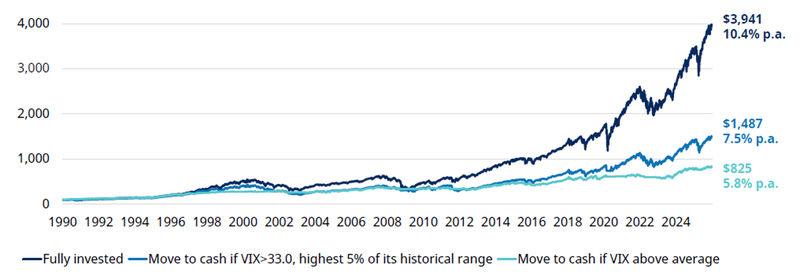
Source: CBOE, LSEG Datastream, Schroders. Notes: Data to 31 December 2025. Shares are represented by the S&P 500 Index. Returns do not consider costs, including transaction costs.
Data from CBOE, LSEG Datastream, and Schroders from the last 35 years highlights that switching out of shares when volatility (VIX Index) increases can have a material impact on an investor’s future wealth. However, everyone’s circumstances are different and we recommend consulting a financial adviser for advice tailored to your situation.
We have useful online tools to help
We know that volatility in the markets can be unsettling, and we're here to help.
- Our MAS Advisers are available to answer your questions and help you make the most of your money. You can call us on 0800 800 627 or email info@mas.co.nz.
- Our Fund Finder can help you see if you're in the right fund for your circumstances.
- Our KiwiSaver Retirement Calculator can help you understand if your retirement savings are on track.
- Log in to myMAS to manage your investments online.
If you decide to change your fund after reviewing your risk profile or meeting with a MAS Adviser, you can make a switch via myMAS. Alternatively, you can complete an investment strategy change request form. There is no fee for switching. Links to the relevant forms are below.
- MAS KiwiSaver Scheme Documents and Forms
- MAS Retirement Savings Scheme Documents and Forms
- MAS Investment Funds Documents and Forms
For more information, you can review our fund performance with returns and weekly unit prices.
Disclaimer
This article is of a general nature and is not a substitute for professional and individually tailored advice. No party guarantees the return of capital or the performance of investment funds. Returns indicated may bear no relation to future performance. The value of investments will fluctuate as the values of underlying assets rise or fall. All returns are in local currency unless otherwise stated.
MAS is a financial advice provider. Our financial advice disclosure statement is available by visiting mas.co.nz or by calling 0800 800 627.
The Product Disclosure Statement for the MAS KiwiSaver Scheme is available at MAS KiwiSaver Scheme.
The Product Disclosure Statement for the MAS Retirement Savings Scheme is available at MAS Retirement Savings Scheme.
The Product Disclosure Statement for the MAS Investment Funds is available at MAS Investment Funds.
Medical Funds Management Limited is the issuer and manager of the Schemes.
More news
Medical students pull off pandemic-era conference
18 July 2022 - The organisers of the 2022 New Zealand Medical Students’ Association Conference believe the experience has taught them skills that will be invaluable to their medical careers.
MAS supports leading Pacific researcher at NZ Women in Medicine conference
14 July 2022 - MAS sponsored Jacinta Fa’alili-Fidow’s (founder and CEO of Moana Connect) keynote speech at the inaugural NZ Women in Medicine Conference, which took place in Wellington in May 2022.