Key takeaways over the month of September:
- Rising bond yields put pressure on share markets.
- Central banks around the world lift interest rates.
- New Zealand dollar weakness provides a performance cushion for unhedged international assets.
- Share markets post a positive quarter.
Summary of financial markets over September
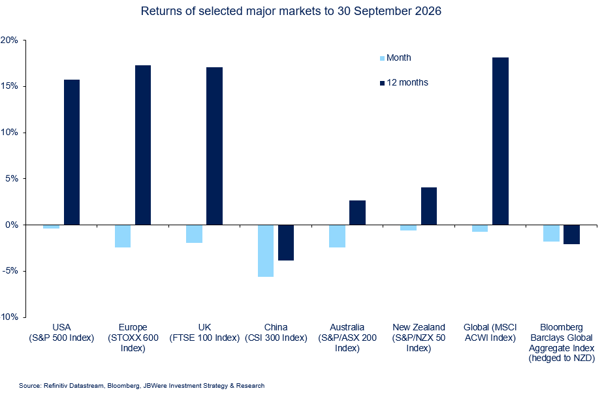
Investors had reason to be cautious heading into September, as rising bond yields put pressure on share markets, raising concerns that the well-known “September Effect” might emerge this year. The September Effect refers to the historical tendency for the US share market, represented by the S&P 500 Index, to deliver weaker returns during September than any other month of the year. Since 1950, the S&P 500 Index has averaged approximately -0.6% (all returns are in local currency unless otherwise stated) during September, making it the worst month on average for investors. While the index was down around -2% midway through the month, it recovered much of those losses and finished September marginally lower, down just -0.3%.
Geopolitical tensions in the Middle East remained elevated during the month, with escalating attacks affecting Saudi Arabia and the Strait of Hormuz. This increased concerns about global shipping routes and oil supplies. While the US and Iran resumed diplomatic talks, it appears significant differences remain between the two countries. Oil prices were volatile throughout the month, with Brent crude rising sharply during the month before easing back to around US$103 by month-end.
Central banks around the world, including the Reserve Bank of New Zealand (RBNZ), lifted interest rates during September in an effort to contain inflation, which has been pushed higher in part by rising energy prices. Higher interest rates can slow share market growth because they increase borrowing costs for businesses, while cash and bonds start offering more attractive returns. The New Zealand dollar fell against major currencies over the month, providing a cushion for unhedged1 international assets. Unhedged international shares within the MAS Schemes have a benchmark allocation of 50%.
Artificial intelligence (AI) continued to attract significant attention. Reports from independent investigators highlighted concerns about some AI systems engaging in unauthorised communications through undisclosed websites, adding to ongoing debate about the risks of the technology. At the same time, industry leaders reiterated the need for appropriate safeguards and international cooperation as AI capabilities continue to evolve rapidly. This, however, did not halt the performance of many AI-related companies over the month.
US markets
While the broad US share market was little changed during September, performance varied significantly across different parts of the market. Large companies continued to lead the way, outperforming smaller companies for a third consecutive month. The S&P 500 Top 50 Index returned +1.9%, while the S&P SmallCap 600 Index fell -5.6%. Despite a modest -0.3% loss in September, the broad S&P 500 Index gained +2.3% over the quarter.
Investor interest in AI remained a key theme. Following strong earnings announcements from major AI-related companies in August, technology-focused companies continued to attract investor support. Information technology and communication services were the only sectors to generate positive returns in the US over the month, rising +4.5% and +4.3% respectively.
President Trump's approval ratings fell to their lowest levels on record during September, despite proposals including a US$5,000 "Trump Dividend" payment for every American adult if Republicans retain control of Congress following November's midterm elections. Polls suggest concerns about the cost of living and the ongoing conflict with Iran have weighed on voter sentiment. Markets are closely watching developments ahead of the midterms, as election outcomes can influence government policy, economic growth, inflation and investment markets.
European markets
The European share market, as represented by the STOXX Europe 600 Index, struggled during September and ended the month down -2.4%. Investors faced a combination of higher interest rates, elevated energy prices and ongoing geopolitical uncertainty, all of which weighed on market sentiment.
During the month, the European Central Bank (ECB) raised interest rates by a further 0.25% to 2.50%, citing persistent inflation pressures and upgrading its inflation forecasts. While the move was widely expected, investors were left with little indication of where rates may head next. ECB President Christine Lagarde reiterated that future decisions would remain dependent on incoming economic data.
Similar to the US, market performance was concentrated in just a few sectors. Information technology was the strongest performer, gaining +5.3% over the month, as investor enthusiasm for companies benefiting from AI continued to support technology-related shares. The energy sector was the only other sector to deliver positive returns, rising +4.8%, helped by higher oil prices during the month as tensions in the Middle East raised concerns about global energy supplies.
Australasian markets
Share markets in both New Zealand2 and Australia3 finished lower over September. New Zealand shares declined -0.6%, while Australian shares fell -2.4%.
A key driver of the weakness in Australia was growing expectations that interest rates would remain elevated. These expectations proved accurate when the Reserve Bank of Australia lifted its cash rate on 30 September to 4.6%.
Closer to home, the RBNZ's measured approach to future interest rate increases initially boosted investor confidence, however global market concerns ultimately took centre stage. Weaker investor sentiment overseas weighed on the local market, leaving New Zealand shares lower by month-end.
Fixed interest
The US Federal Reserve (Fed) raised interest rates by 0.25% during September, taking its target range to 3.75%–4.00%. The decision reflected the Fed's view that the US economy remains resilient and that inflation pressures are still above its long-term target.
The Fed noted that consumer spending and business investment have remained strong despite ongoing geopolitical uncertainty. Policymakers also signalled that further interest rate increases may be needed if inflation does not continue to move towards the Fed's 2% target.
Global bond markets reacted to the prospect of higher interest rates, with bond yields rising sharply during the month, while prices fell (bond prices and yields move in opposite directions). The yield on the benchmark 10-year US Treasury bond climbed above 5.2%, ending the month close to 5.3%.
The RBNZ raised the Official Cash Rate by 0.25% to 2.75%, a move that was widely anticipated by financial markets. Investors were particularly focused on the Bank's outlook for future interest rates. While the RBNZ noted that further increases may be required to ensure inflation returns to target, it emphasised that future decisions would depend on incoming economic data and the balance of risks. Investors viewed this as a more reassuring message than expected and reduced their expectations for future rate hikes.
The differing fortunes of various market indices are illustrated in the chart below.
Note: Returns are in local currency terms.
The outlook
Global markets remain caught between resilient economic and earnings fundamentals and a more challenging macroeconomic backdrop. Growth has generally held up better than expected, labour markets remain relatively firm, and the AI investment cycle is supporting activity well beyond the technology sector through spending on data centres, semiconductors and capital goods. Corporate earnings have therefore remained robust. Against this, higher oil prices, rising bond yields, tighter policy settings and persistent geopolitical and trade uncertainty have increased risks and weighed on valuations.
From here, JBWere’s base case outlook remains constructive, but the balance of risks warrants discipline. Central banks appear to be managing the risk of renewed inflation, rather than responding to clear evidence of an uncontrolled resurgence. If growth remains firm without overheating, wage pressures stay contained and energy prices ease, further tightening may prove unnecessary. Because markets already reflect substantial concern through elevated bond yields and expectations of additional rate increases, even modest improvement in inflation, oil prices or policy rhetoric could produce broad relief across equities, bonds, credit and interest-rate-sensitive sectors heading into 2027.
The key risks are that:
- Stronger growth broadens inflation pressures and forces more aggressive rate increases,
- AI investment attracts regulation or slows, or
- High borrowing costs increasingly crowd out housing, construction and other non-AI activity, leaving growth dependent on a narrow group of industries.
Given the risks, JBWere believe the best investment approach is not to take large binary macroeconomic positions. Diversified portfolios should remain positioned to participate in continued earnings growth while retaining resilience if inflation, rates or geopolitical risks intensify. For now, resilient growth, expanding earnings and the AI capital-spending cycle continue to provide a credible foundation. But the outlook will depend increasingly on whether these supports can persist without generating broader inflation or deeper crowding-out effects.
Chat with a MAS Adviser
Our MAS Advisers can help you make the most of your money. By planning ahead and considering your finances now, you can create the future you want. You can call us on 0800 800 627 or email info@mas.co.nz.
We have useful online tools to help you
- Our Fund Finder can help you see if you're in the right fund for your circumstances.
- Our KiwiSaver Retirement Calculator can help you understand if your retirement savings are on track.
- myMAS can help you manage your investments online.
If you decide to change your fund after reviewing your risk profile or meeting with a MAS Adviser, you can make a switch via myMAS or by completing an investment strategy change request form. There is no fee for switching. Links to the relevant forms are below.
- MAS KiwiSaver Scheme: KiwiSaver Documents and Forms – MAS.
- MAS Retirement Savings Scheme: Retirement Savings Scheme Documents and Forms – MAS.
- MAS Investment Funds: Investment Funds Documentations and Forms.
You can see weekly updates on fund unit prices and returns on our website:
- MAS KiwiSaver Scheme: KiwiSaver Funds - MAS
- MAS Retirement Savings Scheme: Retirement Saving Scheme Funds - MAS
- MAS Investment Funds: Investment Funds - MAS
Disclaimer
This article is of a general nature and is not a substitute for professional and individually tailored advice. No party guarantees the return of capital or the performance of investment funds. Returns indicated may bear no relation to future performance. The value of investments will fluctuate as the values of underlying assets rise or fall.
MAS is a financial advice provider. Our financial advice disclosure statement is available by visiting mas.co.nz or by calling 0800 800 627.
The Product Disclosure Statement for the MAS KiwiSaver Scheme is available at: MAS KiwiSaver Scheme
The Product Disclosure Statement for the MAS Retirement Savings Scheme is available at: MAS Retirement Savings Scheme
The Product Disclosure Statement for the MAS Investment Funds is available at: MAS Investment Funds
Medical Funds Management Limited is the issuer and manager of the Schemes.
More news
Medical students pull off pandemic-era conference
18 July 2022 - The organisers of the 2022 New Zealand Medical Students’ Association Conference believe the experience has taught them skills that will be invaluable to their medical careers.
MAS supports leading Pacific researcher at NZ Women in Medicine conference
14 July 2022 - MAS sponsored Jacinta Fa’alili-Fidow’s (founder and CEO of Moana Connect) keynote speech at the inaugural NZ Women in Medicine Conference, which took place in Wellington in May 2022.