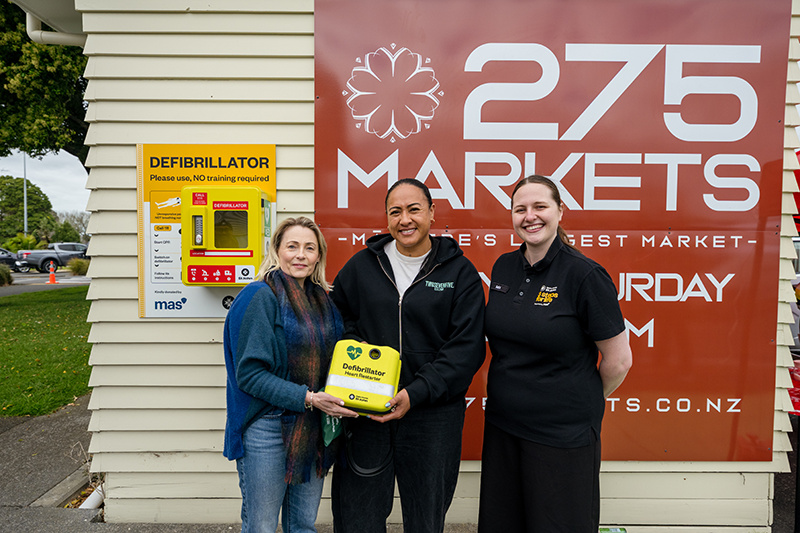
When someone has a cardiac arrest, every second counts. That’s why we’ve donated a community defibrillator to the TWOSEVENFIVE Foundation.
This month, we met with Hato Hone St John and the TWOSEVENFIVE Foundation to handover the public defibrillator at 275 Markets in Māngere.
“We’re grateful to MAS and Hato Hone St John for bringing this lifesaving defibrillator to Māngere,” says TWOSEVENFIVE Foundation co-founder Lily Manase. “It could mean the difference between life and death, and will genuinely save lives here.”
A partnership built on shared values
MAS and Hato Hone St John are united by a shared purpose, helping New Zealanders protect what matters and supporting healthier communities across Aotearoa.
We were originally founded by doctors and our commitment to the health of our communities has stayed with us. Our partnership with Hato Hone St John is already making a difference. Between 1 July 2025 and 30 June 2026, 32,413 people completed 3 Steps for Life programming. That’s well above the programme’s annual target of 27,000.
This October’s Shocktober campaign aims to equip another 17,000 New Zealanders with the skills to respond to a cardiac arrest. More trained people, backed by equipment like the Māngere defibrillator and the St John LifeBeat Mini defibrillators in our MAS Adviser vehicles, means better chances of survival.
Why donate a defibrillator to Māngere?
Cardiac arrests have a significant impact on Māori and Pacific communities, with South Auckland being one of the communities most in need of support.
South Auckland has high rates of cardiac arrest but low community response rates. For Māori, cardiac arrests occur at 1.4 times the rate of non-Māori, and Pacific peoples experience cardiac arrest at 1.3 times the rate of non-Pacific peoples.
Cardiac arrest is likely to strike at a younger age too, with the median Māori patient aged 59 years and Pacific peoples aged 60. This is compared to 69 for non-Māori and non-Pacific peoples.
“This highlights the importance of working alongside communities to increase awareness and help more people survive a cardiac emergency,” says Mia Noyes, 3 Steps for Life Delivery Lead at Hato Hone St John.
Mia says community defibrillation can make a real difference. “When someone has a shockable rhythm, using a defibrillator is associated with a 2.4 times greater chance of survival.”
With 72% of out-of-hospital cardiac arrests occurring at home, community defibrillation can make a real difference. But only 6% of cardiac cases currently receive defibrillation from a Community Responder before an ambulance arrives. Easy access to a defibrillator like this one could change that.
You don’t need to be a paramedic to help
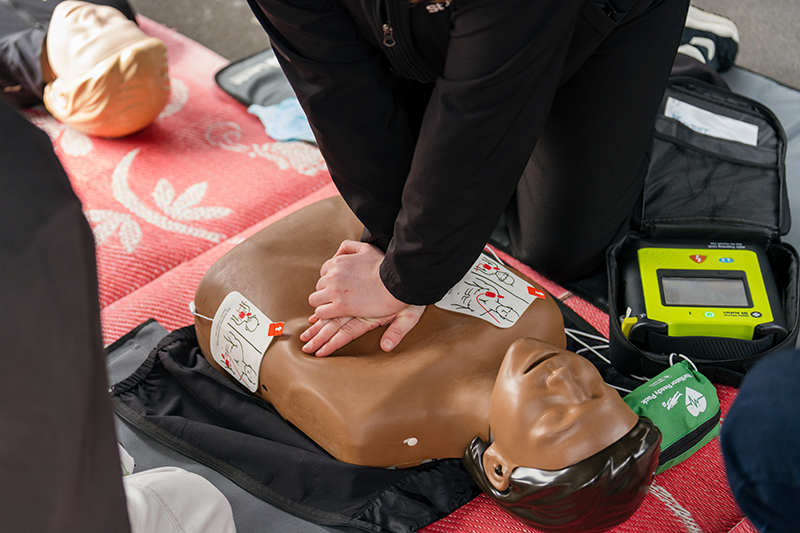
The message is simple: call 111, start CPR and use a defibrillator. Thanks to our partnership with Hato Hone St John, people in Māngere can now do exactly that.
Want to learn how to save a life for free? Book a 3 Steps for Life session.
More news
MAS Member artists exhibiting at Art in the Park
27 October 2026 - In the lead up to Art in the Park, New Zealand’s premier art show, we’re celebrating some of our MAS Members who’ll be exhibiting. Each has a different art style, but all of them show what’s possible when you make space for creativity.
Medical students pull off pandemic-era conference
18 July 2022 - The organisers of the 2022 New Zealand Medical Students’ Association Conference believe the experience has taught them skills that will be invaluable to their medical careers.