Key takeaways over the month of July:
- Share markets were mixed over July. European markets performed well.
- Oil prices spike as tensions rise in the Middle East.
- AI companies come under pressure as investors focus on AI infrastructure buildout.
- Bond yields move higher as inflation concerns rise.
Summary of financial markets over July
A late month rebound helped global share markets1 finish July with little change in US dollar terms. However, because the New Zealand dollar appreciated (rose) during the month, unhedged international shares (which are exposed to currency fluctuations) for domestic investors declined around 3.5% in New Zealand dollar terms. MAS manages this risk by targeting a benchmark hedge ratio of 50% on its international shares exposure.
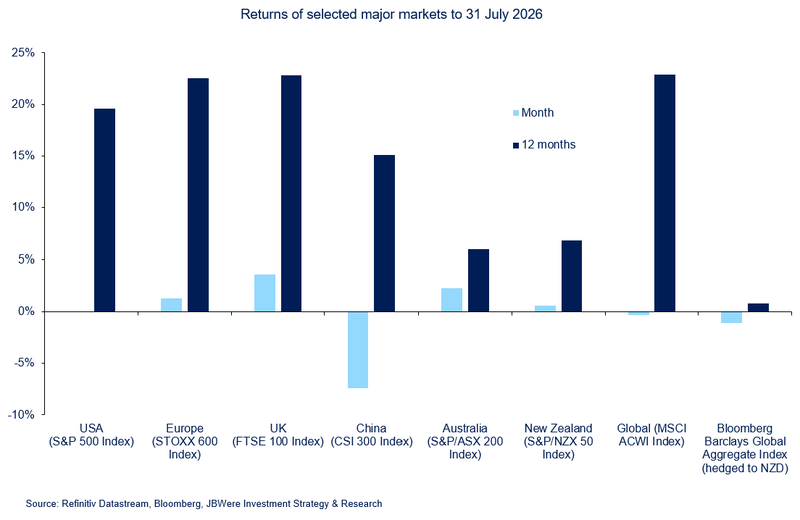
Volatility increased during July as investors responded to ongoing developments in the Middle East and the start of the US company earnings season. European and Australian shares performed well, while returns from US shares ended flat. New Zealand shares experienced a small positive gain. Bond markets were weaker, as investors adjusted their expectations for inflation and the outlook for interest rates.
Events in the Middle East remained a focus for investors during the month. Shipping traffic through the Strait of Hormuz ground to a standstill, sparking concerns about disruptions to global energy supplies. However, oil prices remained relatively contained, ending July around US$90 per barrel, well below their peak levels during the conflict. Increased oil production from major producing countries and demand substitution from China has helped ease some of these concerns.
While geopolitical events continued to attract attention, markets also remained focused on company earnings and economic data. Looking ahead, the World Bank Chief Economist, Indermit Gill, noted that prolonged hostilities in Middle East could slow global economic growth to as low as 1.3%. That’s down from 2.9% last year.
US markets
The US share market2 finished July unchanged, as investors focused on company earnings results and the outlook for future growth. The US reporting season highlighted the importance of company fundamentals, with investors rewarding businesses that exceeded expectations and taking a more cautious view of those that fell short.
While several large technology companies reported solid results, the sector was the weakest-performing over the month, falling 3.4%. Investors became more cautious about the significant spending being committed to artificial intelligence (AI) infrastructure and questioned how quickly those investments will translate into profits.
In contrast, the energy sector was the strongest performer as ongoing tensions in the Middle East supported higher oil prices. Financial companies also enjoyed a positive reporting season, with several major US banks reporting strong earnings supported by resilient economic conditions.
European markets
European share markets closed the month in positive territory, with the Euro STOXX 600 Index rising 1.3%. The European Central Bank (ECB) kept interest rates unchanged at 2.25%. Investors were reassured by comments from ECB President Christine Lagarde that, while inflation risks remain, underlying inflation pressures appear contained. Although the ECB is taking a wait-and-see approach for now, markets are expecting another interest rate increase in September.
Similar to the US market, technology stocks were among the weaker performers, while energy stocks benefited from rising oil prices as tensions in the Middle East escalated.
Andy Burnham officially became UK Prime Minister (PM), making him the seventh PM over the past decade. As expected, he emphasised making changes and moving to a new economic model. The UK’s FTSE 100 Index gained 3.6% over the month.
Australasian markets
Australian3 and New Zealand4 share markets delivered positive returns in July, with Australia rising 2.3% and New Zealand gaining 0.6%. Reflecting broader global trends, the Australian energy sector performed strongly, while technology stocks lagged.
In New Zealand, the share market was supported by signs of an improving economic outlook. Consumer confidence strengthened during the month, and the ANZ Business Outlook Index reached its highest level since February. Offsetting some of this optimism, interest rates moved higher, making bank accounts and term deposits more attractive to some investors.
Fixed interest
The US Federal Reserve (the Fed) left interest rates unchanged at 3.75% during the month. However, its latest projections suggest interest rates could move higher in the future. While the latest US inflation data for June undershot expectations and showed few signs of oil price hikes broadening into other price increases, resilient economic growth and an elevated starting point for inflation suggest the Fed may consider raising interest rates again before the end of the year. Yields generally moved higher during July (yields move in the opposite direct to bond prices), with the US 10-year Treasury yield ending the month at 4.73%.
As anticipated, the Reserve Bank of New Zealand increased the Official Cash Rate by 25 basis points to 2.50%. This marked its first rate hike in three-years and signalled that further tightening is likely to be required to return inflation to the 2% target mid-point. The 10‑year government bond yield finished July at 4.67%.
The differing fortunes of various market indices are illustrated in the chart below.
Note: Returns are in local currency terms.
The outlook
If there has been one defining feature of markets this year, it has been the need to navigate a constant stream of cross currents. July was no exception. At various points during the month, markets had to weigh renewed Middle East tensions, shifting interest rate expectations, technology earnings, AI-related volatility and tariff developments.
Despite this, global equities remain at near record highs and investment returns have generally been decent. Equity markets have ultimately continued to climb the proverbial wall of worry, and our lead Investment Manager, JBWere, expects this to continue. Every new risk and cross current has generated concerns that the rally might finally falter. Instead, markets have repeatedly demonstrated an ability to absorb uncertainty, reassess risks and move forward. A generally resilient economic backdrop has helped enable this. That does not mean risks no longer matter. Rather, it reminds us that investors must be careful not to confuse noise with fundamentals. While the environment remains complex, the most important drivers of long-term market outcomes remain largely unchanged. Economic growth, corporate earnings, labour market conditions, profitability and capital allocation still matter most.
Further shocks are inevitable, but successful investing has never depended on forecasting every turn in the news cycle. It depends on maintaining discipline and focusing on the drivers of long-term value creation. From a distance, markets have appeared far calmer than they have felt day to day. Beneath relatively stable index returns has been a market marked by volatility, shifting narratives and growing dispersion. Artificial intelligence, tariffs, geopolitics and monetary policy have all competed for investor attention, yet the fundamental backdrop has remained notably resilient. In JBWere’s view, that remains the most important signal. In a year defined by uncertainty, maintaining a long-term perspective may prove more valuable than ever.
1As represented by the MSCI All Country World Index.
2As represented by the S&P 500 Index.
3As represented by S&P/ASX 200 Index.
4As rep S&P/NZX 50 Index.
Chat with a MAS Adviser
Our MAS Advisers can help you make the most of your money. By planning ahead and considering your finances now, you can create the future you want. You can call us on 0800 800 627 or email info@mas.co.nz.
We have useful online tools to help you
- Our Fund Finder can help you see if you're in the right fund for your circumstances.
- Our KiwiSaver Retirement Calculator can help you understand if your retirement savings are on track.
- Our MAS Investor Portal can help you manage your investments online.
If you decide to change your fund after reviewing your risk profile or meeting with a MAS Adviser, you can make a switch via the MAS Investor Portal or by completing an investment strategy change request form. There is no fee for switching. Links to the relevant forms are below.
- MAS KiwiSaver Scheme: KiwiSaver Documents and Forms – MAS.
- MAS Retirement Savings Scheme: Retirement Savings Scheme Documents and Forms – MAS.
- MAS Investment Funds: Investment Funds Documentations and Forms.
You can see weekly updates on fund unit prices and returns on our website:
- MAS KiwiSaver Scheme: KiwiSaver Funds - MAS
- MAS Retirement Savings Scheme: Retirement Saving Scheme Funds - MAS
- MAS Investment Funds: Investment Funds - MAS
Disclaimer
This article is of a general nature and is not a substitute for professional and individually tailored advice. No party guarantees the return of capital or the performance of investment funds. Returns indicated may bear no relation to future performance. The value of investments will fluctuate as the values of underlying assets rise or fall.
MAS is a financial advice provider. Our financial advice disclosure statement is available by visiting mas.co.nz or by calling 0800 800 627.
The Product Disclosure Statement for the MAS KiwiSaver Scheme is available at: MAS KiwiSaver Scheme
The Product Disclosure Statement for the MAS Retirement Savings Scheme is available at: MAS Retirement Savings Scheme
The Product Disclosure Statement for the MAS Investment Funds is available at: MAS Investment Funds
Medical Funds Management Limited is the issuer and manager of the Schemes.
More news
MAS Annual Meeting of Members 2026
12 August 2026 – We invite our Members to join us online for the MAS Annual Meeting of Members on Wednesday 26 August 2026 at 7:00pm (NZST).
Report on the MAS Annual Meeting of Members 2026
27 August 2026 - The year saw continued progress in strengthening the Member experience, including enhanced advice capability, improvements to the myMAS digital experience and significant progress towards modernising MAS’s technology platforms.