Key takeaways over the month of October:
- Weakness in technology shares pulled the broader US market into negative territory over the month.
- European and Australian share markets rose, while New Zealand shares ended marginally lower.
- Government bonds generally provided a positive return as demand for perceived safer investments increased.
- The Reserve Bank of New Zealand surprised markets by leaving the Official Cash Rate unchanged.
Summary of financial markets over October
Investment markets delivered mixed results in October as investors balanced resilient economic conditions against persistent inflation, high interest rates and growing questions about the cost of artificial intelligence (AI) investment.
Technology shares came under particular pressure towards the end of the month. Several of the world’s largest technology companies reported continued growth in their AI-related businesses, but investors increasingly focused on whether the substantial amounts being spent on data centres and other infrastructure would translate into higher profits. This contributed to a technology-led sell-off on the final trading day of October. Persistent inflation and the prospect of interest rates remaining higher for longer also contributed to a more cautious mood.
Oil prices also remained an important influence on markets. Higher crude oil prices supported energy companies but reinforced concerns that inflation could remain elevated. Central banks continued to signal that further interest rate increases remained possible, although several decisions during the month suggest a more gradual pace of stimulus removal than markets had anticipated.
US markets
Investor sentiment weakened late in the month following mixed reactions to earnings announcements from some of the largest technology companies. Investors became increasingly focused on the scale of their AI spending. Uncertainty ahead of the US midterm elections also contributed to the more cautious mood. Persistent inflation remained a concern for investors, although the US Federal Reserve (the Fed) provided some relief by leaving interest rates unchanged in the final week of the month.
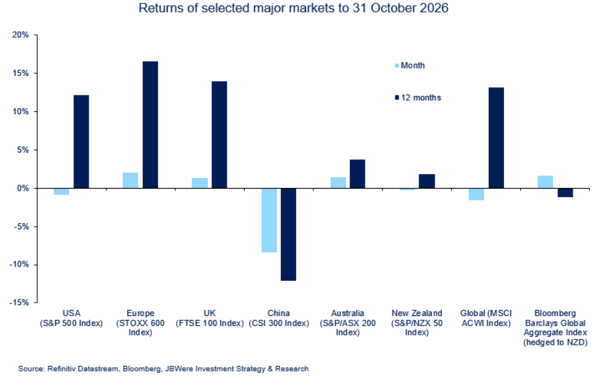
Against this backdrop, the broad S&P 500 Index in the US ended October down 0.9% (all returns are in local currency unless otherwise stated), while the technology-heavy NASDAQ 100 Index fell 6.7%. Performance varied considerably across the US market. Mid-sized companies1 gained 1.9% and smaller companies2 rose 3.2%, while the 50 largest companies in the S&P 500 Index declined 3.3%. This marked a reversal from the September quarter, when the largest companies had generally led the market.
Energy was the strongest-performing sector in the S&P 500 Index, as higher oil prices supported energy companies. In contrast, information technology and communication services declined as investors became more cautious about the scale of spending on AI and how quickly that investment may translate into stronger profits.
European markets
European shares recovered from a difficult September, with the STOXX Europe 600 Index gaining 2.0% in October. Seven of the market’s 11 sectors finished the month higher, although performance varied significantly between industries.
Within the European Index, healthcare was the strongest sector, rising 14%, while energy companies also performed well. Consumer staples, utilities and communication services sectors recovered some of their September losses. Information technology was the weakest sector over October, falling 5%, as concerns affecting global technology companies also influenced European markets.
The European Central Bank left interest rates unchanged during October but indicated that another increase could be considered in December. Policymakers remain concerned that energy prices could add to inflationary pressures, while rising borrowing costs were expected to weigh on economic growth.
Australasian markets
Australian shares rose in October, with the S&P/ASX 200 Index gaining 1.4%. More defensive areas of the market generally performed best as global investors became more cautious about technology companies.
Utilities led the Australian market with a 9.3% gain, followed by the financial sector, up 7.0%, and the healthcare sector, up 6.3%. Materials declined 7.8%, while information technology fell 3.5%. These were the only two Australian sectors to finish the month lower.
New Zealand shares3, finished marginally lower, declining 0.3% over the month. The Reserve Bank of New Zealand (RBNZ) surprised financial markets by leaving the Official Cash Rate (OCR) unchanged at 2.75%. Investors had widely expected a 0.25% increase, and the decision was closely contested, with 4 committee members supporting no change and 3 favouring an increase.
The RBNZ acknowledged that annual inflation had eased to 3.7% but remained above its 3% upper limit target. The Bank also noted that domestic demand was subdued and risks to the global economy had increased.
Fixed interest
Global bonds generally delivered positive returns over the month as investors moved away from shares and towards less risky assets. Expectations for near-term central bank rate increases also eased, contributing to lower bond yields and higher bond prices.
The US 10-year Treasury yield rose to around 5.30% in early October as investors responded to persistent inflation, higher oil prices and the possibility of further interest rate increases. Concerns over competition for capital from the AI build out also played a role. The yield subsequently declined, ending the month at 4.94%, as demand for government bonds increased and the US Federal Reserve left its target interest-rate range unchanged at 3.75%–4.00%.
New Zealand government bond yields also fell over the month, reflecting both the decline in global yields and the RBNZ’s unexpected decision to leave the OCR unchanged. As bond prices rise when yields fall, this generally supported returns from domestic fixed interest investments during October.
The differing fortunes of various market indices are illustrated in the chart below.
The outlook
Global markets remain caught between resilient economic and earnings fundamentals and a more challenging macroeconomic backdrop. Growth has generally held up better than expected, labour markets remain relatively firm, and the AI investment cycle is supporting activity well beyond the technology sector through spending on data centres, semiconductors and capital goods. Corporate earnings have therefore remained robust.
Against this, higher oil prices, elevated bond yields, tighter policy settings and persistent geopolitical and trade uncertainty have increased risks and weighed on valuations. Increasing evidence of constraints in the AI build out (whether it is capital, labour or power) are adding additional factors to consider. From here, JBWere’s base case outlook remains broadly positive, but the balance of risks warrants discipline.
In JBWere’s view, recent AI-related volatility does not signal a slowdown in underlying AI demand. Rather, it reflects investors becoming more discerning about returns, seeking greater clarity on the scale of spending, how it is being financed and when it will translate into profits. Central banks appear to be managing the risk of renewed inflation, rather than responding to clear evidence of an uncontrolled resurgence.
If growth remains firm without overheating, wage pressures stay contained and energy prices ease, further interest rate increases may prove unnecessary. Markets already reflect considerable concern about inflation through elevated bond yields and expectations of additional rate increases. Even modest improvement in inflation, oil prices or policy rhetoric could produce broad relief across equities, bonds, credit and interest-rate-sensitive sectors heading into 2027.
The key risks are that:
- Stronger growth broadens inflation pressures and forces more aggressive rate increases,
- AI investment attracts regulation or slows as constraints bite, or
- High borrowing costs increasingly crowd out housing, construction and other non-AI activity, leaving growth dependent on a narrow group of industries.
Given the risks, JBWere believes the best investment approach is not to take large binary macroeconomic positions. Diversified portfolios should remain positioned to participate in continued earnings growth while retaining resilience if inflation, rates or geopolitical risks intensify. For now, resilient growth, expanding earnings and the AI capital-spending cycle continue to provide a credible foundation. But the outlook will depend increasingly on whether these supports can persist without generating broader inflation or deeper crowding-out effects.
1As represented by the S&P MidCap 400 Index
2 As represented by the S&P SmallCap 600 Index
3 As represented by the S&P/NZX 50 Index
Chat with a MAS Adviser
Our MAS Advisers can help you make the most of your money. By planning ahead and considering your finances now, you can create the future you want. You can call us on 0800 800 627 or email info@mas.co.nz.
We have useful online tools to help you
- Our Fund Finder can help you see if you're in the right fund for your circumstances.
- Our KiwiSaver Retirement Calculator can help you understand if your retirement savings are on track.
- Our MAS Investor Portal can help you manage your investments online.
If you decide to change your fund after reviewing your risk profile or meeting with a MAS Adviser, you can make a switch via the MAS Investor Portal or by completing an investment strategy change request form. There is no fee for switching. Links to the relevant forms are below.
- MAS KiwiSaver Scheme: KiwiSaver Documents and Forms – MAS.
- MAS Retirement Savings Scheme: Retirement Savings Scheme Documents and Forms – MAS.
- MAS Investment Funds: Investment Funds Documentations and Forms.
You can see weekly updates on fund unit prices and returns on our website:
- MAS KiwiSaver Scheme: KiwiSaver Funds - MAS
- MAS Retirement Savings Scheme: Retirement Saving Scheme Funds - MAS
- MAS Investment Funds: Investment Funds - MAS
Disclaimer
This article is of a general nature and is not a substitute for professional and individually tailored advice. No party guarantees the return of capital or the performance of investment funds. Returns indicated may bear no relation to future performance. The value of investments will fluctuate as the values of underlying assets rise or fall.
MAS is a financial advice provider. Our financial advice disclosure statement is available by visiting mas.co.nz or by calling 0800 800 627.
The Product Disclosure Statement for the MAS KiwiSaver Scheme is available at: MAS KiwiSaver Scheme
The Product Disclosure Statement for the MAS Retirement Savings Scheme is available at: MAS Retirement Savings Scheme
The Product Disclosure Statement for the MAS Investment Funds is available at: MAS Investment Funds
Medical Funds Management Limited is the issuer and manager of the Schemes.
More news
Medical students pull off pandemic-era conference
18 July 2022 - The organisers of the 2022 New Zealand Medical Students’ Association Conference believe the experience has taught them skills that will be invaluable to their medical careers.
MAS supports leading Pacific researcher at NZ Women in Medicine conference
14 July 2022 - MAS sponsored Jacinta Fa’alili-Fidow’s (founder and CEO of Moana Connect) keynote speech at the inaugural NZ Women in Medicine Conference, which took place in Wellington in May 2022.