What are bull and bear markets?
By MAS Team
MAS Head of Investment, Dan Mead, explains the ups and downs of the share market.
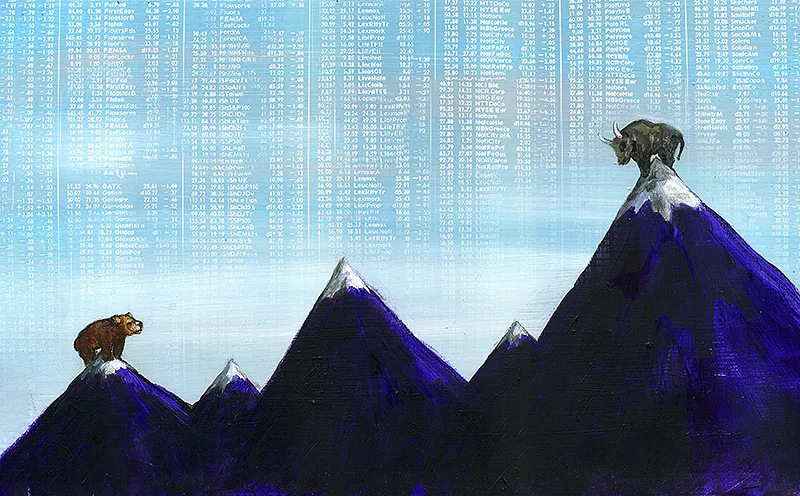
If you’ve spent much time monitoring the rise and fall of share markets over the years, then you might have heard analysts use the terms ‘bull’ and ‘bear’ to characterise them.
These names are a type of shorthand for describing whether the market appears to be in a sustained period of upward growth (bull) or significantly tracking downwards (bear).
The metaphor works like this: A growth market is like a bull, charging forward, horns pointing upwards. During these periods, share prices rise broadly, driven by investor optimism and confidence. A bear market, by contrast, resembles a lumbering beast with paws pointing downwards; prices will be falling and a sense of pessimism and unease prevails.
To put a precise measure on it, a bull market is typically one that has risen by 20% since its most recent low, and a bear is one that has dropped by 20% from its recent high.
A market can transition between a bear and bull due to a combination of factors, such as changes in the economy like inflation, employment rates or GDP fluctuations; political events, such as global tensions, tariffs or political instability; policy changes, such as tax or interest rate changes; and even investors themselves can have an impact if they’re following a herd mentality that sees the market trend in that direction.
While the idea of a period of falling prices might sound unsettling, it’s worth noting that history shows bear markets tend not to last as long as bull markets. A bear market usually lasts for less than 1 year, on average, but a bull market can often last for several years, and in that time, markets may not only recover losses but can also see strong additional growth.
Nevertheless, bear markets can be unsettling for investors. The trick is to not panic and make rash decisions – regardless of what the market is doing. If you do feel worried during a downturn, make time to speak to a MAS Adviser who can help you decide on the best course of action. Redeeming or switching funds out of fear could lead to a worse outcome.
This is because, ultimately, investing is a long-term proposition. The markets will always go up and down, but it’s important to stay focused on your personal goals and what you want to achieve over time. Another way to avoid getting caught up in the moment is to not look at your balance every day. That way you can lift your head above the noise and stay focused on the bigger picture.
The 2008 global financial crisis was a historic bear market triggered by the US subprime mortgage crisis. It saw the S&P 500 drop by approximately 57% from its peak.
This was the longest bull run in stock market history, with the S&P 500 climbing 378% before concluding with the onset of the Covid-19 pandemic.
This was a short but steep bear market triggered by the Covid-19 pandemic. The S&P 500 dropped 34% from its peak in February 2020. This particular bear market lasted for around 1 month.
Whether you’re planning for retirement or growing your wealth, MAS is here to support your financial goals so you can build a future you feel confident about. If you would like to chat with a MAS Adviser about our investment options, call us on 0800 800 627 or email info@mas.co.nz. This is general information only and is not intended to constitute financial advice.

The sooner you begin planning, the better prepared you can be to enjoy a comfortable and worry-free retirement.

We asked a range of talented Kiwi women 5 questions about side hustles, budgeting advice and busting money myths.

Ever checked your KiwiSaver balance only to find it has dropped dramatically overnight? Welcome to the world of sharemarket volatility. In this guide, we'll demystify sharemarket ups and downs for everyday Kiwi investors.