
15 April 2026
Financial markets experienced a difficult March, as heightened tensions between Iran and the US unsettled investors. As April unfolds, however, confidence returns and markets are rebounding quickly. Within a couple of weeks, the US share market1 had recovered the losses seen earlier during the war and was trading back toward its previous highs.
This is a good reminder of why it’s important to stay invested and keep your long‑term goals in mind. Markets can move quickly, both down and up, and stepping out during periods of uncertainty can mean missing the recovery when it comes.
Key takeaways over the month of March:
- Markets were largely driven by events in the Middle East rather than economic data.
- Energy prices rose sharply, supporting energy stocks but weighing on broader markets.
- US equities outperformed other regions.
- Bonds prices experienced pressure from rising inflation expectations and higher yields.
- New Zealand dollar weakness provided a performance cushion for unhedged international assets.
Below is an in-depth review of financial markets over March
After a steady start to the year, financial markets around the world experienced a challenging March. Investors’ focus was almost entirely on the escalating conflict in the Middle East. Heightened geopolitical uncertainty led to sharp swings across markets, pushing share prices lower and driving volatility higher.
Energy prices rose sharply during the month as concerns grew about supply disruption. As a result, the energy sector was the only major sector to deliver positive returns globally during the month. In the US, the S&P 500 Energy sector ended 34% (all returns are in local currency unless otherwise stated) higher over the March quarter. Certain traditionally defensive sectors, such as utilities, held up relatively better than the broader market. Though some others, such as health care and consumer staples, slightly lagged. While sectors more sensitive to economic conditions, including consumer discretionary, industrials and materials, were broadly weaker.
The US share market1 performed relatively better than other regions over March, ending 5.0% lower. Investors rotated back toward higher‑quality companies and markets perceived as more resilient to energy price shocks. As a result of this rotation, European, UK, Japanese and emerging markets generally lagged.
US technology stocks, which had been under pressure earlier in the year, showed some defensive characteristics over March. Software‑focused companies benefited from more resilient earnings profiles. However, communication services stocks underperformed following late‑month share price declines by Meta and Alphabet following a jury finding both companies liable for damages in a key social media addiction lawsuit.
European share market and UK share markets were among the weakest performers globally during March, as investors weighed the impact of the escalating war in the Middle East and sharply higher energy prices. Europe is more exposed than the US to energy supply disruption, and higher oil and gas prices heightened concerns about inflation and slower economic growth. Cyclical sectors such as industrials, consumer discretionary and real estate were particularly weak, as higher energy costs pressured profit margins and household spending. Energy stocks were the notable exception, posting strong gains as oil prices surged.
The Australian share market2 weakened through March, ending 7.2% lower, as higher oil prices lifted inflation concerns and increased the likelihood of further interest rate pressure. With households and businesses still adjusting to earlier rate increases, higher energy costs added to economic uncertainty.
Commodity‑exposed companies, especially certain large and diversified miners, performed relatively well during the month, supported by stronger commodity prices. However, this was not enough to offset broader weakness across the market. Interest‑rate‑sensitive sectors such as consumer discretionary and parts of the financial sector came under pressure.
The New Zealand share market3 also declined during March but performed relatively better than many offshore markets. This reflects the market’s lower sensitivity to global economic cycles and a higher proportion of companies with stable, infrastructurelike earnings. The New Zealand share market closed 5.9% down over the month of March.
While New Zealand has limited direct exposure to the war in Iran, higher fuel and freight costs created indirect pressures for transport, logistics and export‑focused businesses. Some companies were able to offset these costs through pricing power or favourable currency movements, as a weaker New Zealand dollar supported offshore earnings.
Bond markets also experienced volatility during the month. Rising energy prices increased inflation concerns globally, leading to upward pressure on longer‑term interest rates. This resulted in weaker returns for both global and local fixed interest assets during March (bond prices move in the opposite direct to bond yields). In the US, the 2‑year Treasury yield jumped materially over the month, ending March around 3.8%. The New Zealand equivalent also moved higher, finishing the month close to 3.5%.
The New Zealand dollar fell against major currencies over the month, reflecting increased global risk aversion. This currency weakness provided a cushion for unhedged international assets and exporters earning foreign currency revenues.
The differing fortunes of various market indices are illustrated in the chart below.
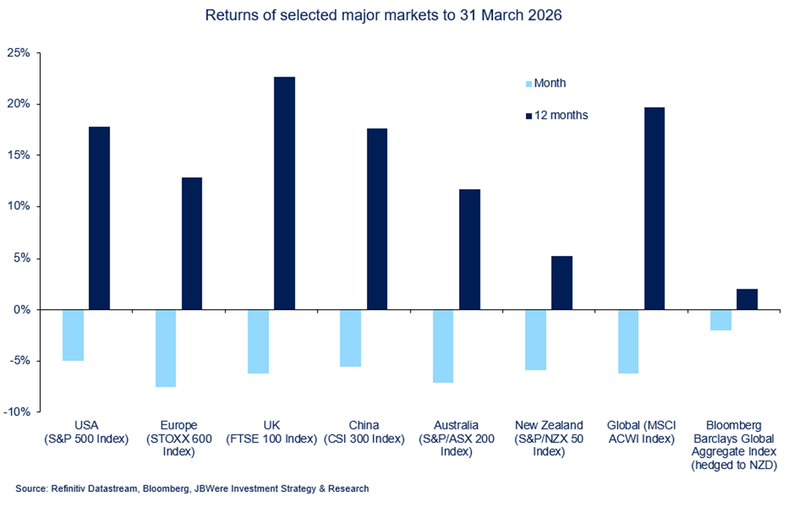
Note: Returns are in local currency terms.
What this means for our funds over the March quarter
The chart below shows selected returns for all funds in the MAS KiwiSaver Scheme. Returns for comparable funds in the MAS Retirement Savings Scheme and the MAS Investment Funds are similar.
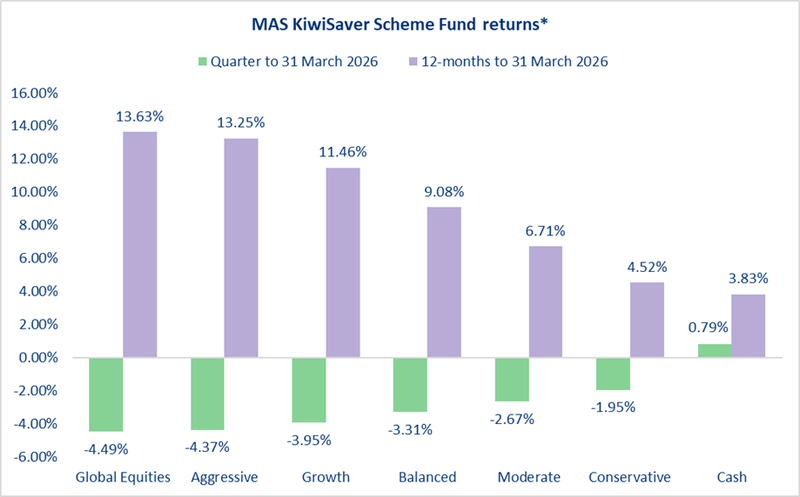
Key points to note from the chart above
- Share markets came under pressure over March as tension escalated into war in the Middle East.
- Conservative funds outperformed more growth orientated funds over the quarter as bonds and cash delivered better relative returns than shares.
- All MAS funds have experienced strong performance over the 12-month period.
The Outlook
The latest conflict in the Middle East has rapidly become the central focus for global financial markets and indeed dominates the near-term investment outlook. Heightened uncertainty now surrounds not only the geopolitical outcome, but also the subsequent effects on energy flows, inflation, economic growth, and market performance.
At the heart of the current crisis lies the disruption to global energy supply. The potential for the ongoing interruption to oil and gas flows has emerged as the key channel through which the conflict influences the global economy. It is unclear how prolonged any disruption may be, how quickly supply can respond, and how policymakers will react. This presents a challenge for investors and markets as they attempt to balance potentially the largest shock to global energy supply ever with the possibility that we are one major headline away from a resolution.
What we can say is that time matters. The longer the disruption persists, the greater the economic cost. And importantly, these costs are unlikely to rise in a linear fashion. In the early stages, higher prices act as a tax on economic activity, but business and consumer behaviour can adapt. However, should the disruption persist and access to physical supply become constrained, the effects can escalate rapidly. Industries reliant on energy may face operational difficulties, supply chains can be impaired, and the hit to global activity can accelerate.
But while the range of potential outcomes is wide, it is important to recognise that all key participants in this conflict face meaningful constraints. For the US, domestic political considerations, especially ahead of midterm elections, limit tolerance for sustained energy price spikes and economic deterioration. The behaviour of financial markets, such as rising bond yields in response to inflation concerns, also exerts pressure on policymakers. Iran, meanwhile, must weigh the risks of escalation against potential damage to its own infrastructure, leadership, and relationships with key economic partners like China and India. These constraints do not eliminate risk, but they create incentives for de-escalation or at least scenarios that allow energy supply to resume, thereby mitigating some of the worst-case economic impacts.
Early signs indicate that constraints are beginning to influence behaviour. Diplomatic engagement, though tentative, is underway, with ceasefire agreements and increased willingness from regional participants to facilitate transit through the Strait of Hormuz. While ongoing military activity and the build-up of US troops suggest that risks remain, these diplomatic and logistical efforts point towards a gradual normalisation of energy flows, which is central to the market outlook. As such, our lead investment manager’s (JBWere) central assumption is that energy supply through the Strait of Hormuz will begin to normalise gradually over the coming weeks (not months). If this assumption proves correct, then the impact on the global economy would likely be manageable, and the shock would fall well short of triggering a more severe downturn. That said, the uncertainty surrounding the situation remains exceptionally high, and alternative outcomes cannot be dismissed.
Notable risks aside, one reason for cautious optimism is the state of the global economy heading into this shock. Growth momentum was resilient, especially in the US, but there were encouraging signs of it broadening to other regions too. Corporate fundamentals were generally solid, with earnings holding up better than expected. In fact, even through March, analysts continued to lift their earnings expectations, especially for 2027. In instances like this, starting points do matter.
As investors, it is also crucial to distinguish between economic outcomes and market performance. History shows financial markets often move ahead of the data, with sentiment improving once the worst-case scenarios start to fade, even before peace is fully restored. Turning points in geopolitical crises can emerge rapidly and unpredictably. In the current crisis, a sustained improvement in sentiment may require only clarity that peak disruption is behind us, not a full conflict resolution. Within the MAS Schemes, our active management style allows us to regularly test and adjust conviction levels when appropriate. Through diversification and exposures to high-quality investments, we believe the MAS Schemes are well placed to respond to a range of possible market outcomes.
We have useful online tools to help you:
- Our Fund Finder can help you see if you're in the right Fund for your circumstances.
- Our KiwiSaver Retirement Calculator can help you understand if your retirement savings are on track.
- Our MAS Investor Portal can help you manage your investments online.
If you decide to change your Fund after reviewing your risk profile or meeting with a MAS Adviser, you can make a switch via the MAS Investor Portal, or alternatively you can complete an investment strategy change request form. There is no fee for switching. Links to the relevant forms are below.
- MAS KiwiSaver Scheme: KiwiSaver Documents and Forms – MAS
- MAS Retirement Savings Scheme: Retirement Savings Scheme Documents and Forms – MAS
- MAS Investment Funds: Investment Funds Documentations and Forms
You can see weekly updates on fund unit prices and returns on our website.
1 As represented by the S&P 500 Index.
2 As represented by S&P/ASX 200 Index.
3 As represented by S&P/NZX 50 Index.
This article is of a general nature and is not a substitute for professional and individually tailored advice. No party guarantees the return of capital or the performance of investment funds. Returns indicated may bear no relation to future performance. The value of investments will fluctuate as the values of underlying assets rise or fall.
MAS is a financial advice provider. Our financial advice disclosure statement is available by visiting mas.co.nz or by calling 0800 800 627.
The Product Disclosure Statement for the MAS KiwiSaver Scheme is available at: MAS KiwiSaver Scheme. The Product Disclosure Statement for the MAS Retirement Savings Scheme is available at: MAS Retirement Savings Scheme. The Product Disclosure Statement for the MAS Investment Funds is available at: MAS Investment Funds. Medical Funds Management Limited is the issuer and manager of the Schemes.