
11 May 2026
Key takeaways over the month of April
- Share markets rebounded strongly following the March sell-off.
- The rebound saw US share markets hit all-time record highs.
- New Zealand shares trailed global markets.
- Bonds yields moved higher, weighing on returns.
Financial markets over April
What a difference a month can make in financial markets. The rebound in global share markets in April was staggering. Investors piled back into shares, choosing to look beyond the ongoing situation in Iran. While geopolitical tensions in the Middle East remain and could heighten from here, investors focused on resilient economic activity and solid company earnings.
US shares rebound strongly
US share markets led the recovery. The S&P 500 Index recorded its strongest monthly gain in more than five years, rising over 10% (all returns are in local currency unless otherwise stated) during April. Technology stocks saw the biggest gains, with the technology-heavy Nasdaq index climbing more than 15% over the month. Both indices finished the month near record highs.
Markets also took comfort from inflation data that broadly met expectations. While price pressures edged higher as the price of oil spiked, the increases were in line with forecasts. This reduced fears of an immediate increase in interest rates. The latest data released in April showed the US economy grew by an annualised 2.0% rate. This was underpinned by robust business spending, primarily in the artificial intelligence (AI) related investment area.
European markets
European share markets delivered positive returns for April, although gains lagged the US. The broad-based Europe STOXX 600 Index rose over 5% over the month. While investor sentiment was more cautious than in the US, markets were supported by a broadly solid reporting season to date.
The underperformance relative to the US largely reflects a relatively smaller technology sector and the region’s greater exposure to disruptions in Iran and the Strait of Hormuz. European countries import a much larger share of its oil and gas than the US. Higher energy prices therefore feed more directly into European inflation and weigh on growth, which has contributed to softer economic momentum. In this environment, central banks have remained cautious, with both the European Central Bank and the Bank of England holding interest rates steady at their April meetings.
Australasian markets
Australian shares rebounded, albeit to a lesser extent, alongside global markets in April. Technology and property stocks lead the gains. More defensive sectors, such as utilities and consumer staples, lagged as investors rotated back toward growth‑oriented industries.
Like Australia, New Zealand small-cap shares1 outperformed larger companies2 over the month, returning 2.4% compared with a -0.21% return from the large-cap index. The New Zealand share market continued to lag behind global peers, reflecting weak domestic economic momentum and fears over Reserve Bank of New Zealand rate hikes.
Fixed interest
Yields on fixed interest investments generally moved higher in April. In the United States, government bond yields edged higher as inflation pressures persisted and expectations for near‑term rate cuts eased. The 10‑year Treasury yield ended the month around 4.3%. Higher yields weighed modestly on fixed‑interest returns.
In New Zealand, government bond yields also moved higher, influenced by global trends and ongoing inflation concerns. The 10‑year New Zealand Government Bond yield fluctuated through the month and finished close to 4.7%, broadly in line with levels seen late in March.
The differing fortunes of various market indices are illustrated in the chart below.
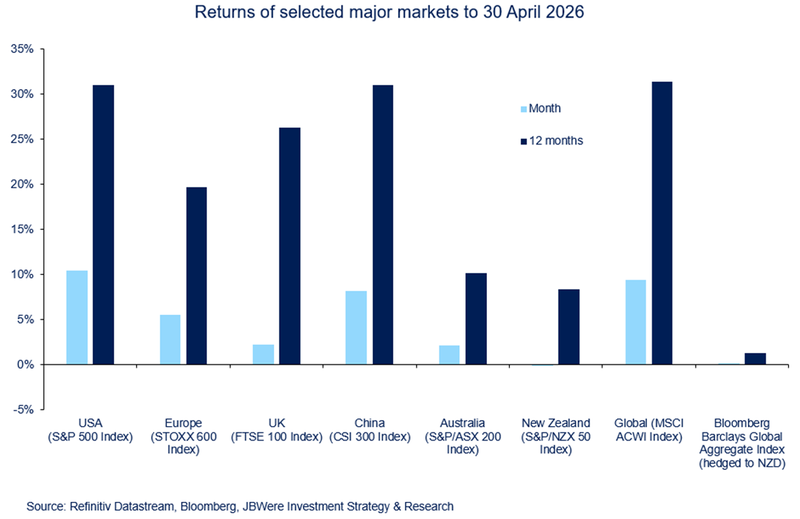
Note: Returns are in local currency terms.
The Outlook
At face value, the strong recovery in global equity markets may seem counterintuitive. This is due to the limited signs of a resolution in the Iran conflict, growing pressures in energy markets and central bank expectations that point towards a tighter monetary policy than was anticipated prior to the conflict. However, this strong recovery is not inconsistent with historical geopolitical episodes that show that equity markets do not require full resolution of uncertainty to recover. Instead, they just need the confidence to reduce the probability placed on some of the most adverse outcomes. A re-engagement with the AI trade has also been a powerful supportive force too, especially in the US.
Are investors now being overly optimistic? Our lead investment manager’s (JBWere) assessment is nuanced. On the one hand, the AI theme once again commands strong attention and has clear momentum. Moreover, the global economy has continually reminded us of its resilience and ability to navigate shocks over recent years. Yet on the other hand, markets have recovered in part because they have priced out the worse-case outcomes. That means they are now more sensitive to any developments that might reintroduce those risks. Clearly the situation remains fluid and volatility is likely to persist. Through this crisis, our specialised investment managers have maintained a disciplined approach, ensuring that their investment processes are maintained.
From here, the key to whether share markets can continue to push higher will come down to fundamentals. While macro dynamics and thematic narratives have supported the recent recovery, ultimately, valuations must be justified by earnings. The current US reporting season suggests a healthy starting point, but risks grow the longer the conflict in Iran persists.
Chat with a MAS Adviser
Our MAS Advisers can help you make the most of your money. By planning ahead and considering your finances now, you can create the future you want. You can call us on 0800 800 627 or email info@mas.co.nz.
We have useful online tools to help you:
- Our Fund Finder can help you see if you're in the right Fund for your circumstances.
- Our KiwiSaver Retirement Calculator can help you understand if your retirement savings are on track.
- Our MAS Investor Portal can help you manage your investments online.
If you decide to change your Fund after reviewing your risk profile or meeting with a MAS Adviser, you can make a switch via the MAS Investor Portal, or alternatively you can complete an investment strategy change request form. There is no fee for switching. Links to the relevant forms are below.
- MAS KiwiSaver Scheme: KiwiSaver Documents and Forms – MAS
- MAS Retirement Savings Scheme: Retirement Savings Scheme Documents and Forms – MAS
- MAS Investment Funds: Investment Funds Documentations and Forms
You can see weekly updates on fund unit prices and returns on our website.
1 As represented by S&P/NZX SmallCap Index.
2 As represented by S&P/NZX 20 Index.
This article is of a general nature and is not a substitute for professional and individually tailored advice. No party guarantees the return of capital or the performance of investment funds. Returns indicated may bear no relation to future performance. The value of investments will fluctuate as the values of underlying assets rise or fall.
MAS is a financial advice provider. Our financial advice disclosure statement is available by visiting mas.co.nz or by calling 0800 800 627.
The Product Disclosure Statement for the MAS KiwiSaver Scheme is available at: MAS KiwiSaver Scheme. The Product Disclosure Statement for the MAS Retirement Savings Scheme is available at: MAS Retirement Savings Scheme. The Product Disclosure Statement for the MAS Investment Funds is available at: MAS Investment Funds. Medical Funds Management Limited is the issuer and manager of the Schemes.