Putting nature first in Kaituna Valley
By MAS Team
Canterbury conservation crusaders Mark Nixon and Megan Reynolds are dedicating their time and resources to restoring Kaituna Valley’s flora and fauna.
We’ve just experienced the coolest year of the rest of our lives, suggests Mark Nixon. It’s been a confusion of heatwaves interspersed with hailstorms – clear signals that our planet is under stress. And Mark, together with wife Megan Reynolds, will not sit idly by.
“We want to look our as-yet unconceived grandchildren in their unconceived eyes and be able to tell them that we tried our best to turn back the tide,” says Megan. “If everyone did a little bit, we might get somewhere.”
‘Getting somewhere’ is certainly the goal for MAS Members Mark and Megan, who formed Mikimiki Conservation Trust 3 years ago in order to protect and enhance native flora and fauna. Their trust then purchased a 410ha block of land on Banks Peninsula, and that’s where they spend most of their time, working towards regeneration.
Both are medically trained (Mark jokes that he “only went to medical school to find a wife”), and they’ve each enjoyed fulfilling careers: Megan spent 17 years in sexual health at Christchurch Hospital; Mark co-founded ARANZ Medical 30 years ago, a company specialising in wound imaging and prosthetics, and still sits on the board of what is now a global business.
While most retired doctors and executive directors might be using their newfound freedom to travel the world, it’s not a path Mark and Megan wish to take. Instead, they spend long, happy days killing old man’s beard (wild clematis), removing wilding pines, trapping possums and stoats, and observing bird and insect life at Tūpari Reserve, the name they’ve given the land.
When working on the property, the couple live in their housetruck. Bought sight unseen on Trade Me 21 years ago, the truck was, at first, a nifty enabler of economical summer holidays. Mark, Megan and their 3 children would head up to Nelson, where they parked the truck and spent precious time together. But conservation was never far from their minds. It’s clear that these planet-conscious people have always been broad thinkers; they were early adopters of electric vehicles, eat a vegetarian diet and are best described as quiet greenies.
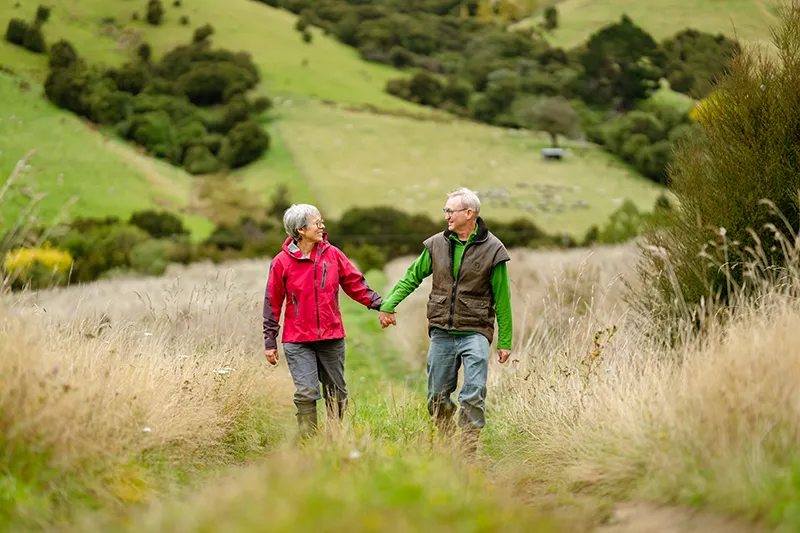
Their journey into the big green unknown started when they bought a smaller 40ha block of land near Akaroa – “our gateway drug” laughs Megan – before hearing of a much larger farm in Kaituna Valley. Endowing the newly purchased land to the trust, their gift was complemented 3 years later by a second purchase and endowment, made by another conservation-focused couple, taking the total area to 730ha.
As they continue to pour blood, sweat and (rarely) tears into this land, the hope is that one day, the trust will be financially self-sustaining. “We’re looking at the option of selling carbon credits and potentially doing some eco-tourism accommodation,” says Megan.
For now, the only dwelling on the reserve is home to 3 ecology students, paid interns getting stuck into weeding while gaining practical skills, knowledge and experience along the way. One thing they’re not doing is planting native trees, because at Tūpari Reserve the team follows natural regeneration principles.
“The main barrier to native seedlings establishing is the grass,” explains Mark. To help with this, there’s an unexpected ally: gorse. “Using gorse as a nursery crop has been pioneered on Hinewai Reserve nearby. It’s proved that, over several decades, it can invade grassland and encourage native trees that grow through, shade out and then proceed to kill the gorse.”
Megan admits some of the local rural community have scratched their heads at the couple’s vision. “Traditional farmers spend their lifetime getting rid of gorse, grazing hills that are lovely and grassy. It must be hard for them to understand that a couple of greenies want to turn the hills back to golden yellow!”
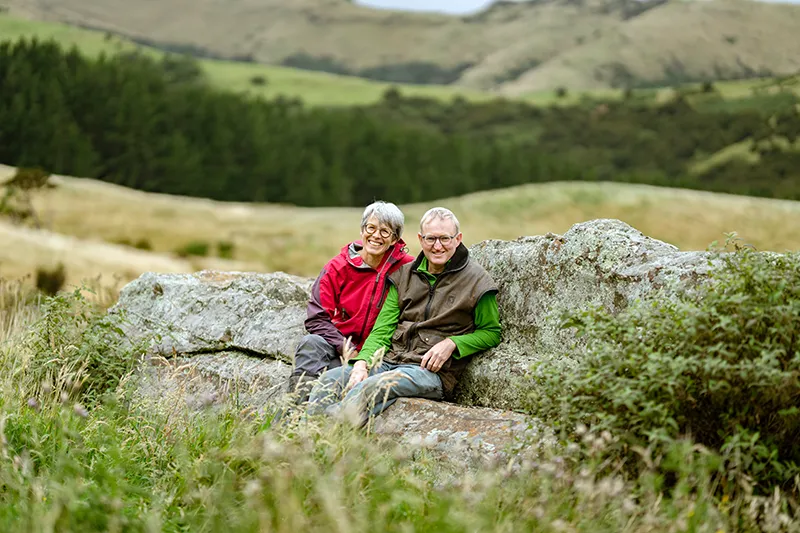
But it’s working. Along with the removal of grazing stock from the block, the nature lovers have noticed undergrowth returning and birds flocking – little markers of success in what can be, at times, a physically arduous, mentally taxing lifestyle. Thank goodness they have help, with a small band of committed volunteers visiting every few weeks.
“There’s Max and Di, who are 75-plus but so young at heart and absolute models of volunteering. There’s a recently retired civil servant, an ex-DOC worker, and an engineering graduate we met while sleeping on the same bench on the Kepler Track,” says Megan, numbering them off.
Mark and Megan also guide tramping groups and interested walkers over the land, too, on tracks they have built following old stock routes. In January, they opened an alternative route to the much-loved Packhorse Hut, allowing walkers to complete the hike as a round trip.
Spray, secateurs, traps, boundary fencing and so much more… Does it all cost an absolute bomb? Well, yes. “But writing the cheque is the easy part,” says Megan. Not that she’s being flippant about what they’ve spent so far. “It’s managing a property of this size that challenges us the most, and also working to be accepted into a new community.”
Indeed, in Kaituna Valley, everyone knows everyone, and as Mark and Megan quickly discovered, social occasions revolve around the Kaituna branch of the Red Cross, which organises Christmas parties, movie nights, and fundraising events. “It’s a real sense of community where people truly look after each other – and I think they’ve all got pretty green hearts too,” Megan says.
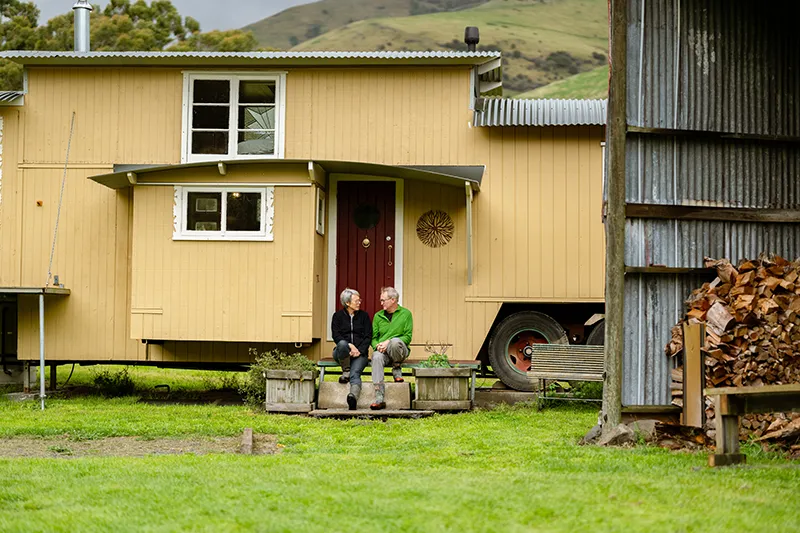
Life in the housetruck isn’t quite as rustic as one might imagine. “We’re living it only slightly rough” Megan emphasises. There’s electricity (solar would be preferred, but there’s not quite enough sunlight in winter to enable it), an incinerating toilet and plenty of vegetables passed on by their new neighbours, which, Megan adds, “is great because our diet can get a bit muesli-based, if I’m honest.”
Sometimes they forage. Megan admits to being fascinated by the smaller, less charismatic species, including the fungi, springing into life at Tūpari. They’ve even named their conservation trust Mikimiki after the ubiquitous small-leaved coprosma shrub. “If you look after those little, more boring guys, the big guys look after themselves,” Megan explains.
The philosophy of every small step being part of a system also applies to a life from which international travel is consciously absent. While contemporaries are jetting off to Europe or spending a New Zealand winter in Bali, Mark and Megan say they can’t justify the carbon burned by flying. “Unless people like us who can, don’t, nothing’s going to change,” Mark says, and Megan agrees. “It’s a minor sacrifice, really, if you think of what’s at stake, which is the health of the planet. After all, the first rule of medicine is to do no harm.”
Besides, she concludes, why would they want to be anywhere other than this beautiful slice of paradise? “It’s quite nice to be locked away here, noticing what nature showcases to you. We see some amazing rare bugs, fragile native plants and things most people never will.”

What started out as an opportunity to raise money for an important charity turned into an experience of personal growth and life-long friendships.

Artistic entrepreneur and MAS Member Evie Kemp shares her passion for helping others embrace their own innate creativity.
We caught up with a recent MAS Here for Good Scholarship recipient and surf lifesaving volunteer turned trainee midwife, who says lessons learned at the beach are now helping her in the birthing suite.