Key takeaways over the month of June:
- Share markets were mixed over June. European markets performed relatively well.
- The domestic S&P/NZX 50 Index outperformed its Australian counterpart.
- New Zealand government bond yields declined as falling oil prices helped ease inflation risks.
Summary - Financial markets over June
After a strong rebound from the geopolitical-related market weakness seen earlier in the year, global share markets delivered mixed results in June. European and domestic shares performed relatively well, while returns in the US were more subdued. Bond yields (yields move in the opposite direction to bond prices) declined in a number of major markets, as easing oil prices helped reduce inflation concerns.
Concerns about higher energy prices eased during the month as tensions in the Middle East showed signs of cooling. Shipping through the Strait of Hormuz gradually resumed, helping to reduce fears of continued supply disruptions and inflationary pressures. As a result, oil prices fell, with WTI crude oil ending the month at around US$70 per barrel, down from a peak of approximately US$118 per barrel during the height of the conflict.
US markets
The US share market1 experienced a volatile month in June as developments in the Middle East continued to influence investor sentiment. The memorandum of understanding between the US and Iran initially reassured investors, however renewed tensions in the Strait of Hormuz later in the month contributed to periods of uncertainty and market volatility.
The broader US share market1 finished June modestly lower, although it still recorded its strongest quarterly gain since 2020. The technology-led rally that had driven much of the market's performance earlier in the year paused in June, with investors favouring more defensive sectors such as health care. While technology shares fell during the month, the sector remained the strongest performer over the June quarter.
A major US market highlight was the public listing of SpaceX. Shares debuted at US$135 and rose around 19% on their first day of trading. This lifted the company's market value above US$2 trillion, making it one of the largest initial public offerings (IPOs) ever. Despite its size, only a small portion of SpaceX shares are currently available for public trading, with the majority remaining held by founders, employees and existing shareholders. The MAS Funds did not participate in the SpaceX IPO.
European markets
European share markets performed relatively well in June, with the Euro STOXX 600 Index returning 2.7%. Investors became more confident as concerns about energy supplies eased and oil prices fell later in the month. While the European Central Bank continued its efforts to keep inflation under control by raising interest rates by 0.25%, lower energy costs helped ease inflation worries and supported both share and bond markets.
Shares in the UK2 produced a positive result over the month, gaining 1.0%. Markets took political developments largely in their stride, with Prime Minister (PM) Keir Starmer announcing his resignation after losing support within the Labour Party. He will remain as PM until Labour elects a new leader later this year. The new PM will be Britain’s 7th in the last 10 years.
Australasian markets
Australian3 and New Zealand4 share markets rose over June, with Australia gaining 0.7% and New Zealand rising 2.9%. In Australia, resource and materials stocks lagged the broader market over the month, reflecting ongoing uncertainty around global demand. While energy stocks experienced heightened volatility as oil prices responded to changing geopolitical tensions.
New Zealand shares performed relatively well over the month. While global events continued to influence markets, strong performances from some of New Zealand’s larger companies, including Fisher & Paykel Healthcare (on the back of a weaker NZD/USD) and a2 Milk (which secured two additional registrations in China for its infant formula), being key drivers of returns.
Fixed interest
The US Federal Reserve (the Fed) voted to leave interest rates unchanged at 3.75%, however its revised projections pointed to the possibility of higher interest rates to come. Inflation, including energy prices, jumped 0.5%, lifting annual inflation to 4.2%. These two factors suggest the US Fed may look at increasing interest rates at least once before the end of the year.
In New Zealand, bond yields declined over the month as falling oil prices and ongoing evidence of sluggish economic growth helped ease inflationary concerns, reducing the likelihood of significant interest rate increases. The 10‑year government bond yield finished around 4.4%.
The differing fortunes of various market indices are illustrated in the chart below.
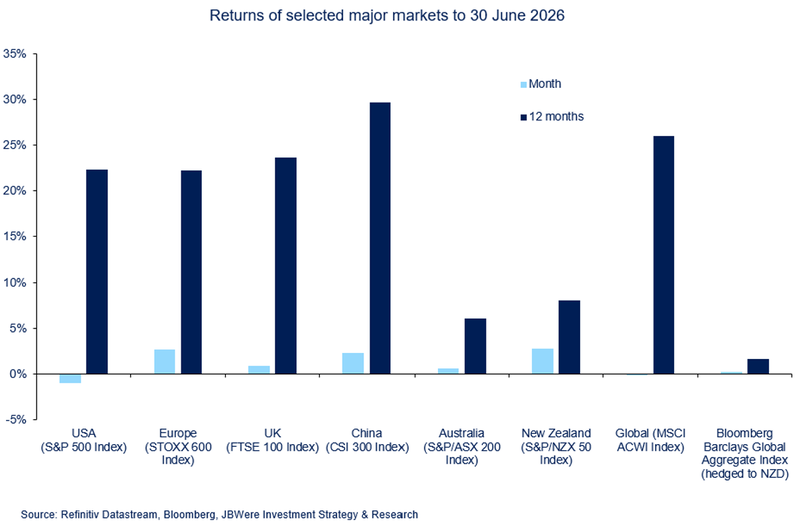 Note: Returns are in local currency terms.
The outlook
With the first half of the year now behind us, one thing is clear: financial markets have had no shortage of things to focus on. Few periods have felt as dynamic, with meaningful geopolitical, economic, and corporate developments all competing for investor attention.
Through all the noise, several implications stand out. The combination of resilient economic growth (especially as oil price risks recede), stable labour markets and strong corporate earnings should remain supportive for equities. Yet the environment is becoming more dependent on execution. Valuations are not cheap, and together with some signs of investor crowding and exuberance, this has likely lowered the market’s tolerance for disappointment.
The first half of the year demonstrated that markets could navigate uncertainty, albeit with increased volatility. Investors should prepare for further volatility, especially in a world where relative winners and losers are being questioned on a daily basis. The most obvious beneficiaries are from AI infrastructure spending, and their businesses are compelling, but they are not without their risks. Increasingly attractive opportunities may emerge among businesses that have been overlooked of late. Diversification is still important, and this remains of paramount importance within the MAS funds.
And finally, if there is one overarching lesson from the first half, it is that fundamentals matter. Stronger corporate earnings growth expectations have driven global equity markets higher this year. That principle is unlikely to change in the second half of this year or in 2027.
1As represented by the S&P 500 Index.
2As represented by the FTSE 100 Index
3As represented by S&P/ASX 200 Index.
4As represented by S&P/NZX 50 Index.
Chat with a MAS Adviser
Our MAS Advisers can help you make the most of your money. By planning ahead and considering your finances now, you can create the future you want. You can call us on 0800 800 627 or email info@mas.co.nz.
We have useful online tools to help you
- Our Fund Finder can help you see if you're in the right fund for your circumstances.
- Our KiwiSaver Retirement Calculator can help you understand if your retirement savings are on track.
- Our MAS Investor Portal can help you manage your investments online.
If you decide to change your fund after reviewing your risk profile or meeting with a MAS Adviser, you can make a switch via the MAS Investor Portal or by completing an investment strategy change request form. There is no fee for switching. Links to the relevant forms are below.
- MAS KiwiSaver Scheme: KiwiSaver Documents and Forms – MAS.
- MAS Retirement Savings Scheme: Retirement Savings Scheme Documents and Forms – MAS.
- MAS Investment Funds: Investment Funds Documentations and Forms.
You can see weekly updates on fund unit prices and returns on our website:
- MAS KiwiSaver Scheme: KiwiSaver Funds - MAS
- MAS Retirement Savings Scheme: Retirement Saving Scheme Funds - MAS
- MAS Investment Funds: Investment Funds - MAS
Disclaimer
This article is of a general nature and is not a substitute for professional and individually tailored advice. No party guarantees the return of capital or the performance of investment funds. Returns indicated may bear no relation to future performance. The value of investments will fluctuate as the values of underlying assets rise or fall.
MAS is a financial advice provider. Our financial advice disclosure statement is available by visiting mas.co.nz or by calling 0800 800 627.
The Product Disclosure Statement for the MAS KiwiSaver Scheme is available at: MAS KiwiSaver Scheme
The Product Disclosure Statement for the MAS Retirement Savings Scheme is available at: MAS Retirement Savings Scheme
The Product Disclosure Statement for the MAS Investment Funds is available at: MAS Investment Funds
Medical Funds Management Limited is the issuer and manager of the Schemes.
More news
MAS KiwiSaver Scheme tops latest MJW Investment Survey
28 July 2026 - The latest Melville Jessup Weaver (MJW) Investment Survey (June 2026) has recognised the MAS KiwiSaver Scheme as one of New Zealand's top-performing KiwiSaver providers.
MAS reports strong performance and sets out long-term vision for Members
30 July 2026 - MAS has today released its 2026 Annual Report, highlighting a year of strong financial performance, significant investment in Members and communities, and a renewed focus on creating a more connected, Member-first organisation.