Jump to section (newest first):
- GI Policy Wording Changes - Summary - 1 July 2026
- Fire and Emergency Levy Changes 1 July 2026
- Business Risk Statutory Liability Exclusion update due amendment of the Resource Management Act 1991 – 8 October 2025
- GI Policy Wording Changes - Summary - 1 July 2024
- Natural Hazards Insurance Act 2023 (effective from 1 July 2024)
- Fire and Emergency Levy Increase from 1 July 2024
- MAS insurance premium factors 2024
- EQC cap and levy rate changes
- Changes to Business Risks Premiums (effective from 1 September 2022)
- Changes to House, Contents and Motor Vehicle Premiums (effective from July 2022)
- New design and language for House, Contents and Motor Vehicle Policies (effective on renewal from 28 March 2022)
- Corrections to multi-product and Goldshield discounts
- Changes to Motor Vehicle Premiums (effective from 8 September 2021)
- New exclusions added to General Insurance policies (effective from 1 July 2021)
GI Policy Wording Changes - Summary - 1 July 2026
This summary highlights changes to your MAS General Insurance (GI) policy wording. These changes are to provide greater clarity, support our Members’ needs and update references to legislation.
Importantly, this document is not part of your contract of insurance with MAS. It is only a summary of the enhancements and changes, so please ensure you read your renewal documents and the full policy wordings, which are available on our website at mas.co.nz
You can also request a copy of your policy wording to be emailed or posted to you by emailing us at info@mas.co.nz or calling our Member Support Centre team on 0800 800 627 (select option 2).
Note: The changes in this document will apply to you if you are renewing your policy on or after 1 July 2026.
House Insurance Policy, including Holiday Home, Lifestyle Property House and Residential Rental Property Policies
|
What has changed? |
Where you can find this in your policy document |
|
We have clarified that your policy schedule takes precedence over all if there is a difference in the information provided within your policy schedule, policy wording and any endorsement notices. |
|
|
To ensure your rights relating to your privacy are clear, we have added a new section titled ‘Your privacy’. This section outlines that we collect and use personal information in accordance with our privacy statement and where you can find more information about what can, and cannot be done with this information, to make sure we comply with the Privacy Act 2024. |
|
|
Example 1 within the existing sections outlining when we need to be notified of changes to certain circumstances has been amended. Previously this example ‘1. renting out the property or leaving it unoccupied for a period of more than 60 days’ combined two examples that are not in any way dependent on each other. We have separated this point into two to make it clear they are not connected. |
|
|
The terms for cancellation have been updated to explain that when we accept a claim resulting in a total loss and the full sum insured or full area replacement is paid to you, your policy will automatically be cancelled as you would have exhausted the full amount of cover available for that policy. |
|
|
A new section: Excesses you may need to pay has been introduced to help further clarify when an excess may be payable and the value. We have clarified where this information is found within the policy. |
|
|
We have made an update to clarify when an excess will apply and in what situation more than one excess will apply. This is to give you clearer expectations of your costs when it comes time to make a claim. We have also added some information around NHCover claims and provided clear direction on where to find out when an NHCover excess is applicable and how much that NHCover excess will be. |
|
|
A new defined term House glass has been created. The purpose of this definition is to clearly define the glass within the home that will not require an excess to be paid when it needs to be repaired or replaced under the Glass breakage benefit. |
|
|
The Glass breakage automatic additional benefit has been updated to utilise the newly defined term ‘house glass’ within the benefit to make it clear the glass within the home that is covered under this benefit. |
|
|
We have clarified the intended coverage offered by the Hidden gradual loss automatic additional benefit as it can only be claimed once per term, regardless of how many policies you have with us. |
|
|
The Landscaping automatic additional benefit has been updated to clarify that a claim for the loss to the house or other insured property must have been accepted before you are able to claim for loss to your landscaping. The loss to the landscaping must have been caused by the same event as the loss to the house or other property. |
|
|
A new exclusion Pollution, contamination and seepage has been introduced due to the high risks of coverage along with loss relating to this cause being largely avoidable. With the right care, attention or use of an alternative product; pollution, contamination or seepage can be avoided. We do acknowledge that some products, such as asbestos or lead paint, were previously considered compliant with earlier building code or relevant law at the time they were incorporated into the house. For this reason, we will cover the loss if the cause of the exposure was due to a sudden accidental event, where the contaminant or pollutant was previously lying dormant, and the use of the contaminant or pollutant was consistent with the building code or relevant law at the time it was used for the construction of the property. |
|
|
From 1 July the No Claims Bonus (NCB) discounts will be removed (including Secured NCB), and the adjustment is reflected in the base rates. You will continue to be able to make claims confidently, without any current impact to your premium. Additional information about this change can be found on our website. As a result, the additional automatic benefit ‘Glass breakage’ and ‘Locks and keys’ have had all references to this Secured No Claims Bonus structure removed. |
|
|
We have introduced a new exclusion Animals for any damage caused by domestic pets at rental properties. Damage caused by domestic pets to rental properties will not be covered. The same level of care is often not taken by tenants with pets, compared to owner-occupied homes with pets. It can be difficult to determine whether the loss caused by the tenant’s pet is accidental, or whether it is a gradual issue that has occurred over an extended period due to a lack of care taken with the pet.
|
|
|
A new exclusion Illegal drugs has been created for any loss caused by illegal drugs. Loss due to illegal drugs occurs due to a purposeful action occurring that is against the law. The conditions under Policy Introduction - House use - Rental property section are intended to prevent loss caused by illegal drugs from happening.
|
|
|
Due to the addition of the illegal drugs exclusion, we have removed some wording within the rental property conditions as one of the conditions listed, is now addressed under this new exclusion. We have also expanded on who these conditions should be met by to include either the Member, or a Property Manager, as Property Managers are often utilized by Homeowners to make sure their obligations to fulfil these conditions are carried out. |
|
|
As a result of not covering any loss related to illegal drugs, we have amended the terms under what you are not covered for, to include methamphetamine contamination damage within clause 1. (h). |
|
|
A new definition Methamphetamine contamination damage has been added to clarify what we mean by methamphetamine contamination damage. |
|
|
We have introduced some limited cover up to $30,000 per event for Methamphetamine contamination damage under a new Methamphetamine decontamination automatic additional benefit. While we will not cover loss due to illegal drugs as outlined within the newly added ‘illegal drugs’ exclusion, we do understand that sometimes tenants can be misleading, even when they are checked properly. It can be difficult to completely prevent loss due to the use, consumption, storage, distribution, or manufacture of methamphetamine or precursor substances required to manufacture methamphetamine (including contamination damage arising from the storage of the precursor substances) by tenants. We have added this benefit to offer limited cover when loss has occurred, even though you have followed all the conditions laid out within the ‘Policy Introduction - House use -Rental property’ section. An additional excess of $2,000 will apply for cover under this benefit. |
|
|
To clarify what we mean by the contamination level used within the new Methamphetamine decontamination automatic additional benefit, we have added a new defined term Contamination level. |
|
|
The defined term Uninhabitable has been amended to include methamphetamine contamination damage, or contamination of the house as a possible cause. |
|
Contents Policy, including Holiday Home Contents, Lifestyle Property Contents and Residential Rental Property Contents Policies
|
What has changed? |
Where you can find this in your policy document |
|
We have clarified that your policy schedule takes precedence over all if there is a difference in the information provided within your policy schedule, policy wording and any endorsement notices. |
|
|
To ensure your rights relating to your privacy are clear, we have added a new section titled ‘Your privacy’. This section outlines that we collect and use personal information in accordance with our privacy statement and where you can find more information about what can, and cannot be done with this information, to make sure we comply with the Privacy Act 2024. |
|
|
Some text has been removed that explained how your policy works, as we have addressed the same point with the new text added to How your policy works - Your policy and how it works. |
|
|
Example 1 has been amended. Previously this example ‘1. renting out the property or leaving it unoccupied for a period of more than 60 days’ combined two examples that are not in any way dependent on each other. We have separated this point into two to make it clear they are not connected. We have updated example 4. within the same section to include more of the items we would want to know about due to applicable sub-limits to these items. We have also added some additional wording to help guide you to the right section of the policy that will outline the items that are restricted to a sub-limit so there is one source of truth to what these limits are. |
|
|
The terms for cancellation have been updated to explain that when we accept a claim resulting in a total loss and the full sum insured or full area replacement is paid to you, your policy will automatically be cancelled as you would have exhausted the full amount of cover available for that policy. |
|
|
A new section: Excesses you may need to pay has been introduced to help further clarify when an excess may be payable and the value. We have clarified where this information is found within the policy. |
|
|
We have made an update to clarify when an excess will apply and in what situation more than one excess will apply. This is to give you clearer expectations of your costs when it comes time to make a claim. |
|
|
From 1 July the No Claims Bonus (NCB) discounts will be removed (including Secured NCB), and the adjustment is reflected in the base rates. You will continue to be able to make claims confidently, without any current impact to your premium. Additional information about this change can be found on our website. As a result, the additional automatic benefit ‘Cyber-bullying’, ‘Locks and keys’ and ‘Personal health items’ have had all references to this Secured No Claims Bonus structure removed. |
|
|
Wording has been removed due to the existing definition for personal health items. The listed items have been removed to avoid repetition as they form part of the definition already. |
|
|
A new title Items restricted to a sub-limit has been added making this section of wording outlining the items with restrictive limits easier to identify. We have amended the first sentence within this section introducing the list of items within the Lifestyle Property Contents Policy for consistency. We have added some additional text to help clarify the existing intended coverage for personal health items. When a pair of hearing aids or set of contact lenses or dentures are claimed on due to loss caused by one event, the pair or set counts as one item and is limited to $10,000 total. |
|
|
We have clarified the intended coverage offered by the Hidden gradual loss automatic additional benefit as it can only be claimed once per term, regardless of how many policies you have with us. |
|
|
Insulin pumps have been added to the list of items we consider under the Personal health item definition. You will no longer have to specify insulin pumps unless you need more than $10,000 coverage for your pump. If you need cover higher than $10,000, you need to specify these items. We have also made an amendment to the item list by reviewing whether the item is generally used in a singular or plural sense for better readability. |
|
|
We have corrected an error within the second table to reflect the correct limit of $2,500 (as referenced on page 10 under the Hidden gradual loss automatic additional benefit). |
|
Motor Policy
|
What has changed? |
Where you can find this in your policy document |
|
We have introduced a new automatic additional benefit: MAS Roadside Assistance. This benefit will allow eligible Motor Vehicle Policy holders with Comprehensive cover to access roadside assistance that will be provided by AA Roadservice (terms and conditions apply). There is no need to wait for your policy to renew to access this service, you can access this service immediately. This benefit has been provided at no cost to our Members and there is no applicable excess to use any standard MAS Roadside Assistance AA Services. However, some of the services that require additional support or technical assistance outside of the standard AA Services may require an up-front cost to be covered by the driver of your vehicle. |
Section 1: Loss to your property – Automatic additional benefits, Motor Vehicle (p 22) |
|
We have clarified that your policy schedule takes precedence over all if there is a difference in the information provided within your policy schedule, policy wording and any endorsement notices. |
How your policy works - Your policy and how it works, Motor Vehicle (p 8) |
|
To ensure your rights relating to your privacy are clear, we have added a new section titled ‘Your privacy’. This section outlines that we collect and use personal information in accordance with our privacy statement and where you can find more information about what can, and cannot be done with this information, to make sure we comply with the Privacy Act 2024. |
How your policy works - Your policy and how it works, Motor Vehicle (p 9) |
|
The terms for cancellation have been updated to explain that when we accept a claim resulting in a total loss and the full market value or sum insured is paid to you, your policy will automatically be cancelled as you would have exhausted the full amount of cover available for that policy. |
How your policy works - Cancelling your policy, Motor Vehicle (p 11) |
|
A new section: Excesses you may need to pay has been introduced to help further clarify when an excess may be payable and the value. We have clarified where this information is found within the policy. |
How your policy works, Motor Vehicle (p 13) |
|
We have added new wording to clarify when an excess will apply and in what situation more than one excess will apply. This is to give you clearer expectations of your costs when it comes time to make a claim. |
How your policy works - One event - one excess, Motor Vehicle (p 13) |
|
From 1 July the No Claims Bonus (NCB) discounts will be removed (including Secured NCB), and the adjustment is reflected in the base rates. You will continue to be able to make claims confidently, without any current impact to your premium. Additional information about this change can be found on our website. As a result, the additional automatic benefit ‘Glass breakage’, ‘Locks and keys’ and ‘Not at fault’ have had all references to this Secured No Claims Bonus structure removed. |
How your policy works – Secured No Claims Bonus, Motor Vehicle (p13) |
|
Clause 3. a) has been amended to clarify intent. The subclause allows cover for mechanical, electrical, or electronic failure or loss to your vehicle if it is caused by a fire to your vehicle. |
Section 1: Loss to your property - What you are not covered, Motor Vehicle (p 26) |
|
The legal liability limit for damage to property, along with the total for any event, has increased from $10 million to $20 million. This increase in limit is to make sure MAS is offering Members competitive coverage for their legal liability if they were to be found liable for property damage due to the use of their insured vehicle. |
Section 2: Legal liability – What you will receive, Motor Vehicle (p 32) |
|
We have removed non-factory modifications as it is not relevant to legal liability and was an error. |
Section 2: Legal liability - what you will receive, Motor Vehicle (p 32) |
|
The definition of Accessories has been updated for relevance of modern accessories and to ensure the examples provided are not interpreted as an exhaustive list. The definition allows for technology changes. |
Section 5: Definitions, Motor Vehicle (p 44) |
|
A new definition for Modifications has been added to help clarify the key differences between an accessory and a modification. |
Section 5: Definitions, Motor Vehicle (p 47) |
|
We have updated example 1. to remove the explanation of what a modification is as there is now a definition. |
How your policy works - Tell us when things change Motor Vehicle (p 10) |
|
The paragraphs addressing Modifications and roadworthiness have been simplified due to the introduction of the Modification definition. |
Policy introduction - Your vehicle and drivers, Motor Vehicle (p 16) |
|
We have simplified the exclusion Modifications due to the introduction of the Modifications definition. |
Section 3: General exclusions, Motor Vehicle (p 35) |
Boat Policy
|
What has changed? |
Where you can find this in your policy document |
|
We have clarified that your policy schedule takes precedence over all if there is a difference in the information provided within your policy schedule, policy wording and any endorsement notices. |
Welcome - Your policy and how it works, Boat (p 5) |
|
To ensure your rights relating to your privacy are clear, we have added a new section titled ‘Your privacy’. This section outlines that we collect and use personal information in accordance with our privacy statement and where you can find more information about what can, and cannot be done with this information, to make sure we comply with the Privacy Act 2024. |
Welcome - Your policy and how it works, Boat (p 5) |
|
The terms for cancellation have been updated to explain that when we accept a claim resulting in a total loss and the full market value or sum insured is paid to you, your policy will automatically be cancelled as you would have exhausted the full amount of cover available for that policy. |
Welcome – Cancellation, Boat (p 6) |
|
A new section: Excesses you may need to pay has been introduced to help further clarify when an excess may be payable and the value. We have clarified where this information is found within the policy. |
Welcome, Boat (p 6) |
|
We have added new wording to clarify when an excess will apply and in what situation more than one excess will apply. This is to give you clearer expectations of your costs when it comes time to make a claim. |
Welcome - One event - one excess, Boat (p 6) |
|
Some text within the Locks and keys automatic additional benefit has been removed that referenced a No Claims Bonus structure. The Boat wording does not have this feature available for the product. It was included in error as there is the same Locks and keys benefit where a No Claims Bonus is available within our main House, Contents and Car product offering. |
Section One: Loss to your property, Boat (p 9) |
Contract Works Policy
|
What has changed? |
Where you can find this in your policy document |
|
We have clarified that your policy schedule takes precedence over all if there is a difference in the information provided within your policy schedule, policy wording and any endorsement notices. |
Contract Works Insurance, Contract Works (p 3) |
|
To ensure your rights relating to your privacy are clear, we have added a new section titled ‘Your privacy’. This section outlines that we collect and use personal information in accordance with our privacy statement and where you can find more information about what can, and cannot be done with this information, to make sure we comply with the Privacy Act 2024. |
Contract works Insurance, 9. Your privacy (p 7) |
|
A definition for Act has been added to explain what we mean by an Act and to incorporate any changes or amendments made to the Acts referenced within the wording. |
11. Definitions, Contract Works (p 7) |
Goods in Transit and Goods in Storage Policy
|
What has changed? |
Where you can find this in your policy document |
|
We have clarified that your policy schedule takes precedence over all if there is a difference in the information provided within your policy schedule, policy wording and any endorsement notices. |
Welcome - Your policy and how it works, Goods in Transit and Goods in Storage (p 5) |
|
To ensure your rights relating to your privacy are clear, we have added a new section titled ‘Your privacy’. This section outlines that we collect and use personal information in accordance with our privacy statement and where you can find more information about what can, and cannot be done with this information, to make sure we comply with the Privacy Act 2024. |
Welcome - Your policy and how it works, Goods in Transit and Goods in Storage (p 5) |
|
The terms for cancellation have been updated to explain that when we accept a claim resulting in a total loss and the full sum insured or full area replacement is paid to you, your policy will automatically be cancelled as you would have exhausted the full amount of cover available for that policy. |
Welcome – Cancellation, Goods in Transit and Goods in Storage (p 6) |
Fire and Emergency Levy Changes 1 July 2026
From 1 July 2026, the way the Fire and Emergency Levy is charged on insurance policies in New Zealand will change.
The levy is charged for property that is insured against the risk of fire within New Zealand.
The basis for calculating the levy will now be based on the sum insured within all insurance contracts for fire damage, previously the indemnity value of the property has been used for this calculation for non-residential buildings.
All motor vehicle insurance policies will be charged a flat fee for the levy, regardless of the vehicle’s weight.
The definition for residential property will change, specifically to address how mixed-use buildings are levied.
Buildings that are considered mixed-use will pay a residential property levy rate on the parts of that building that are considered residential. The non-residential parts of that mixed-use building will pay a non-residential property levy rate.
The levy rates have been assigned based on the proportion of time and resources used by the Fire and Emergency Department when responding to an event at each type of property.
For more information on the changes to the Fire and Emergency Levy, please refer to the Fire and Emergency website: The Fire and Emergency levy | Fire and Emergency New Zealand
Business Risk Statutory Liability Exclusion update due amendment of the Resource Management Act 1991 – 8 October 2025
On 21 August 2025, the Government amended the Resource Management Act 1991 (RMA), making it unlawful to insure fines or infringement fees resulting from breaches of the RMA. This affects all Statutory Liability insurance policies with MAS and cover for these costs will now be excluded.’
|
What has changed? |
Where you can find this in your policy document |
|
We have added an exclusion to the Statutory Liability Exclusions for any fine or infringement fee imposed under the Resource Management Act 1991 as it is now unlawful to insure fines or infringement fees that result from breaches of the RMA. |
|
GI Policy Wording Changes - Summary - 1 July 2024
This summary highlights changes to your MAS General Insurance (GI) policy wording. These changes are to provide greater clarity, support the Mutual and our Members’ needs, and to update references to legislation.
Importantly, this document is not part of your contract of insurance with MAS. It is only a summary of the enhancements and changes, so please ensure you read your renewal documents and the full policy wordings, which are available on our website at mas.co.nz
You can also request a copy of your policy wording to be emailed or posted to you by emailing us at info@mas.co.nz or calling our Member Support Centre team on 0800 800 627 (select option 2).
Note: The changes in this document will apply to you if you are renewing your policy on or after 1 July 2024.
House Insurance Policy, including Holiday Home, Lifestyle Property House & Residential Rental Policies
|
What has changed? |
Where you can find this in your policy document |
|
We have clarified that the accidental death benefit only applies when you die in a sudden accidental event caused by accidental loss to the property covered by the policy. |
|
|
We have made 3 changes to the Locks and Keys Benefit. We have limited the benefit to $2,000 for any one event. We will only provide the benefit on an excess-free basis for the first claim. Subsequent claims may impact your No Claims Bonus. |
|
|
We have replaced references to ‘natural disaster’ with ‘natural hazard’ to align our definitions with the new Natural Hazards Insurance Act, which replaces the Earthquake Commission Act from 1 July 2024 onwards. |
|
|
We have introduced a new $20,000 Sustainability Upgrade benefit, which provides additional cover for using sustainable products if you need to rebuild your home. |
|
|
We have reduced the limit for the automatic retaining wall benefit from $200,000 to $100,000. Members can still request higher limits for an additional premium. |
|
|
We have limited cover for loss caused by storm flood or landslip for the first 48 hours of new policies that aren’t replacing an existing MAS policy or are not taken out at the same time as you purchase the house. |
|
|
We have simplified the definition of restricted perils, because those perils are now covered by the new natural hazards definition. |
|
|
We have added a definition to clarify when a house may be deemed uninhabitable by MAS. |
|
|
References to the Earthquake Commission Act 1993 have been replaced with the Natural Hazards Insurance Act 2023. All references to the EQC Act, EQC and EQCover have been replaced by the NHI Act, NHC, and NHCover, respectively. |
|
|
We have simplified and clarified the cancellation clause in the policy. Members can still cancel a policy at any time without a notice period. MAS will now also have a right to cancel at any time on 30 days’ prior notice to the affected Member. This change brings MAS policies into line with other policies in the insurance market and is necessary to run a prudent insurance business. The 30-day notice period is intended to give Members enough time to investigate alternative cover options, if they are impacted by MAS exercising its right to cancel. |
|
|
We have clarified the one event one excess benefit. This benefit only applies when you need to claim under multiple policies for loss caused by a single event at the same location. |
|
|
We have removed the section describing our complaints process. You can find that information on our website at www.mas.co.nz/contact/make-a-complaint/ |
|
Contents Policy, including Holiday Home Contents, Lifestyle Property Contents and Residential Rental Property Contents Policies
|
What has changed? |
Where you can find this in your policy document |
|
We have clarified the application of the accidental death benefit. It is only available when you die in a sudden accidental event caused by your household contents. |
|
|
We have made 3 changes to the Locks and Keys Benefit. We have limited the benefit to $2,000 for any one event. We will only provide the benefit on an excess-free basis for the first claim. Subsequent claims may impact your No Claims Bonus. |
|
|
We have replaced references to ‘natural disaster’ with ‘natural hazard’ to align our definitions with the new Natural Hazards Insurance Act, which replaces the Earthquake Commission Act from 1 July 2024 onwards. |
|
|
We have changed the definition of ‘personal effects’ to exclude items that are not normally worn by or carried on you such as bicycles and musical instruments. |
|
|
We have simplified the definition of ‘restricted perils’, because those perils are now covered by the new natural hazards definition. |
|
|
We have added a definition to clarify when a house may be deemed uninhabitable by MAS. |
|
|
We have simplified and clarified the cancellation clause in the policy. Members can still cancel a policy at any time without a notice period. MAS will now also have a right to cancel at any time on 30 days’ prior notice to the affected Member. This change brings MAS policies into line with other policies in the insurance market and is necessary to run a prudent insurance business. The 30-day notice period is intended to give Members enough time to investigate alternative cover options, if they are impacted by MAS exercising its right to cancel. |
|
|
We have clarified the one event one excess benefit. This benefit only applies when you need to claim under multiple policies for loss caused by a single event at the same location. |
|
|
We have removed the section describing our complaints process. You can find that information on our website at www.mas.co.nz/contact/make-a-complaint/ |
|
Motor Policy
|
What has changed? |
Where you can find this in your policy document |
|
We have simplified the glass breakage clause in the policy. Window glass is now defined. |
|
|
We have made 3 changes to the Locks and Keys Benefit. We have limited the benefit to $1,000 for any one event. We will only provide the benefit on an excess free basis for the first claim. Subsequent claims may impact your No Claims Bonus. |
|
|
We have extended the definition of ‘vehicle’ to include accessories both in and on the vehicle. |
|
|
We have excluded panoramic sunroofs, mirrors and lights from the definition of window glass. |
|
|
We have simplified and clarified the cancellation clause in the policy. Members can still cancel a policy at any time without a notice period. MAS will now also have a right to cancel at any time on 30 days’ prior notice to the affected Member. This change brings MAS policies into line with other policies in the insurance market and is necessary to run a prudent insurance business. The 30-day notice period is intended to give Members enough time to investigate alternative cover options, if they are impacted by MAS exercising its right to cancel. |
|
|
We have clarified the one event one excess benefit. This benefit only applies when you need to claim under multiple policies for loss caused by a single event at the same location. |
|
|
We have removed the section describing our complaints process. You can find that information on our website at www.mas.co.nz/contact/make-a-complaint/ |
|
Boat Policy
|
What has changed? |
Where you can find this in your policy document |
|
We have made 3 changes to the Locks and Keys Benefit. We have limited the benefit to $1,000 for any one event. We will only provide the benefit on an excess free basis for the first claim. Subsequent claims may impact your No Claims Bonus. |
|
|
We have simplified and clarified the cancellation clause in the policy. Members can still cancel a policy at any time without a notice period. MAS will now also have a right to cancel at any time on 30 days’ prior notice to the affected Member. This change brings MAS policies into line with other policies in the insurance market and is necessary to run a prudent insurance business. The 30-day notice period is intended to give Members enough time to investigate alternative cover options, if they are impacted by MAS exercising its right to cancel. |
|
|
We have clarified the one event one excess benefit. This benefit only applies when you need to claim under multiple policies for loss caused by a single event at the same location. |
|
|
We have removed the section describing our complaints process. You can find that information on our website at www.mas.co.nz/contact/make-a-complaint/ |
|
Contract Works Policy
|
What has changed? |
Where you can find this in your policy document |
|
We have replaced references to ‘natural disaster’ with ‘natural hazard’ to align our definitions with the new Natural Hazards Insurance Act, which replaces the Earthquake Commission Act from 1 July 2024 onwards. |
|
|
References to the Earthquake Commission Act 1993 have been replaced with the Natural Hazards Insurance Act 2023. All references to the EQC Act, EQC and EQCover have been replaced by the NHI Act, NHC, and NHCover respectively. |
|
Goods in Transit and Goods in Storage Policy
|
What has changed? |
Where you can find this in your policy document |
|
We have changed the definition of ‘personal effects’ to exclude items that are not normally worn by or carried on you, such as bicycles and musical instruments. |
|
|
We have replaced references to ‘natural disaster’ with ‘natural hazard’ to align our definitions with the new Natural Hazards Insurance Act, which replaces the Earthquake Commission Act from 1 July 2024 onwards. |
|
|
We have simplified the definition of ‘restricted perils’, because those perils are now covered by the new natural hazards definition. |
|
|
References to the Earthquake Commission Act 1993 have been replaced with the Natural Hazards Insurance Act 2023. All references to the EQC Act, EQC and EQCover have been replaced by the NHI Act, NHC, and NHCover respectively. |
|
|
We have simplified and clarified the cancellation clause in the policy. Members can still cancel a policy at any time without a notice period. MAS will now also have a right to cancel at any time on 30 days’ prior notice to the affected Member. This change brings MAS policies into line with other policies in the insurance market and is necessary to run a prudent insurance business. The 30-day notice period is intended to give Members enough time to investigate alternative cover options, if they are impacted by MAS exercising its right to cancel. |
|
|
We have removed the section describing our complaints process. You can find that information on our website at www.mas.co.nz/contact/make-a-complaint/ |
|
Natural Hazards Insurance Act 2023 from 1 July
From 1 July 2024 there will be new governing legislation, the Natural Hazards Insurance Act 2023 (NHI Act). This Act modernises and replaces the Earthquake Commission Act 1993 (EQC Act).
What’s changing
From 1 July 2024, EQC Toka Tū Ake will change its name to Natural Hazards Commission Toka Tū Ake (NHC) as part of the Natural Hazards Insurance Act taking effect. Read more at www.naturalhazards.govt.nz
The other noticeable change for policy holders, is that policy schedules and invoices will now reference an NHI levy instead of EQC levy and NHCover instead of EQCover.
The NHI Act introduces changes to improve the experience of homeowners who need to make a natural hazards insurance claim. The NHI Act takes into account lessons learnt from the Canterbury earthquake sequence, the Kaikōura earthquake, and other natural hazard events, as well as the Public Inquiry into the Earthquake Commission completed in 2020.
Your insurance provider will manage your NHI claim
In the event your home is damaged by a natural hazard event, please contact MAS to make a claim. We will assess and manage your claim from start to finish, including the NHCover portion on NHC’s behalf. MAS will be your single point of contact during the claim process and can answer any questions you have.
Where to go for more information
Please go to naturalhazards.govt.nz/know-your-cover/ to find out more about how the NHI Act affects cover and claims.
Fire and Emergency Levy Increase from 1 July 2024
What’s changing?
For renewals and new business from 1 July 2024, the Fire and Emergency (FENZ) levy rate has increased as shown in the table below.
|
|
Current rate |
New rate |
|
Domestic buildings |
|
|
|
Domestic contents |
|
|
|
Vehicles with a gross laden weight (GLW) 3.5 tonne or under |
|
|
|
Other property (includes Business Risks policies) Levy is payable on property insured against the risk of fire in New Zealand. Property includes:
|
|
|
Note: the above rates are exclusive of GST.
What is the FENZ levy?
The FENZ levy is used to fund Fire and Emergency New Zealand, so that they have the resources to respond to:
- fires
- floods
- vehicle incidents
- animal rescues
- and more.
We are required by law to collect the levy and pass it on to FENZ.
Further information
You can find out more about the FENZ levy rate changes on the FENZ website.
MAS insurance premium factors 2024
Each year when MAS insurance policies renew, we apply an inflation rate to the insured amount. This helps your cover to remain suitable over time so that future claims under each policy can be paid appropriately. The inflation rates used have generally remained consistent each year, but we do benchmark them against external sources such as the Capital Goods Price Index data series from Statistics NZ.
When inflation rates are adjusted on MAS policies, premiums are also likely to adjust as they are calculated as a percentage of the amount insured on the policy.
Severe weather events
The severe weather events across the country during 2023 have have had a significant impact on MAS home, contents, motor vehicle, and business insurance portfolios. The risk of similar events occurring in the future is priced into insurance premiums as they renew.
For those living in flood-prone areas, premiums will increase over time across the insurance industry as the nature and impact of these risks become better understood.
Increasing reinsurance costs
Reinsurers are the ‘insurance companies for insurance providers’, so they provide insurance cover for insurers across the globe, including MAS. This allows us to insure against most of the costs of a catastrophic event like an earthquake or cyclone, protecting our capital reserves.
Traditionally, the primary risk reinsurers have considered in New Zealand is seismic. Due to the increasing frequency and severity of weather events, reinsurers are beginning to look at Aotearoa New Zealand differently and they are beginning to pass through significant increases in reinsurance premiums to New Zealand insurers. These costs are a significant portion of operating costs, so increases will be factored into premiums as they renew.
We can help with options
It is important to retain appropriate levels of cover in case the worst happens – a lesson reinforced by the sheer scale of flooding and storm damage to properties, contents, and motor vehicles in January and February this year.
We have a useful contents calculator on our website that can help you assess whether you have appropriate contents cover in place. Just enter your address to get started.
However, if you’d like to discuss options to optimise your premiums or to discuss your cover, please email us at info@mas.co.nz or call us on 0800 800 627.
Changes to Business Risks Premiums (effective from 1 September 2022)
MAS is committed to providing consistent and fair value premiums for Members over time, which is why we are adjusting premiums for our Business Risks policies.
Key things we are changing
Minimum premiums are increasing to meet the costs of providing cover.
Contents cover rates are increasing and will vary across a number of sum insured bands resulting in a different outcome across levels of cover.
Why the changes are needed
We regularly review our products and pricing structures to make sure they are suitable and continue to protect what matters most to our Members now and for the future.
These reviews consider the frequency and cost of claims, future costs of providing cover, economic indicators such as energy prices, increasing costs of goods and services and global supply constraints, environmental factors such as increased severe weather events, and the financial requirements of MAS.
When will these changes take effect?
We will introduce the new rates effective 1 September 2022 for all new policies we issue. For existing policies, the new rates will apply to your policy at renewal.
Your renewal pack and tax invoice will contain your new total annual premium payable.
Does the insurance still meet your needs?
It is important that you regularly review your cover and cover limits, and that you also make sure you understand what is and what is not covered.
Our specialist Business Risk Advisers can help you with this and help you with the right balance between the cost of the covers and the cost of the risk.
If you would like to speak to a specialist Business Risk Adviser about these changes, or for a general check-up on your insurance needs, please call us on 0800 800 627 or email us at businessinsurance@mas.co.nz.
Changes to your House, Contents and Motor Vehicle Premiums (effective from July 2022)
MAS is committed to providing consistent and fair value premiums for Members over time, which is why we are adjusting premiums for our General Insurance policies.
Why the changes are needed
We regularly review our products and pricing structures to make sure they are suitable and continuing to protect what matters most to our Members now and for the future. These reviews consider the future costs of providing cover, economic indicators such as energy prices, increasing costs of goods and services and global supply constraints, environmental factors such as increased severe weather events, and the financial requirements of MAS.
Key things we are changing
General rate increases across House, Contents and Motor Vehicle Policies.
House
- Inflation rate increase on residential buildings to align with national indexing practices.
- Standard excess increasing to $500
Contents
- Standard excess increasing to $500.
Motor Vehicle - Comprehensive, Third Party, Fire and Theft, Third Party Fire and Theft
- National vehicle indexing adjustments to reflect current vehicle sums insured.
- Reduction of the Named Drivers discount to 10%*.
*Over 25's Driver Option and Named Drivers Only.
Over 25's Driver Option and Named Drivers Only option will now give the same discount of 10% on your premium. If you have selected Named Drivers Only and choose to swap to Over 25's, which has fewer policy restrictions, we can change this with no additional impact to your premium.
When you have selected Named Drivers Only on your policy, authorised drivers are restricted to only those drivers you have nominated, limited to 5 regular drivers. When you have selected Over 25's on your policy, authorised drivers are restricted to only those over the age of 25 driving your vehicle without needing to be individually named. Additional excesses are payable in the event of a claim if these policy conditions are not met. To discuss if the options you have previously selected are still appropriate for you, please call us on 0800 800 627 or email us here.
When these changes will take effect
We will introduce the new rates in July 2022 for all new policies we issue. For existing policies, the new rates will apply to your policy at renewal.
Your renewal notice will contain your new total annual premium payable.
Does the insurance still meet your needs?
It's important to review your insurance regularly to make sure it continues to meet your needs.
If you would like to speak to an adviser about these changes, the ongoing affordability of your insurance, or for a general check-up on your insurance needs, please call us on 0800 800 627 or email us here.
New design and language for House, Contents and Motor Vehicle Policies (effective on renewal from 28 March 2022)
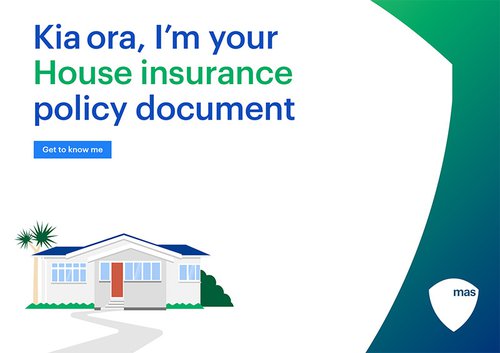 During 2021, in an effort to further improve your MAS Member experience, we have updated our house, contents, and motor vehicle policy documents making them easier to read, understand, and navigate.
The changes involve rewriting the documents in line with plain language principles. Where possible complex legal or insurance terms have been explained more simply, and unnecessary legal and insurance jargon has been removed.
The documents have also been redesigned to incorporate digital navigation tools in order to help you find policy information more easily.
While these changes are intended purely to improve the design and readability of the documents and not affect the terms and conditions of the policy, there are a couple of changes you should be aware of that we have made to better reflect the way the policies are managed in practice. These changes are explained below.
House policy document
We have made the following changes to the house policy in relation to natural disaster cover:
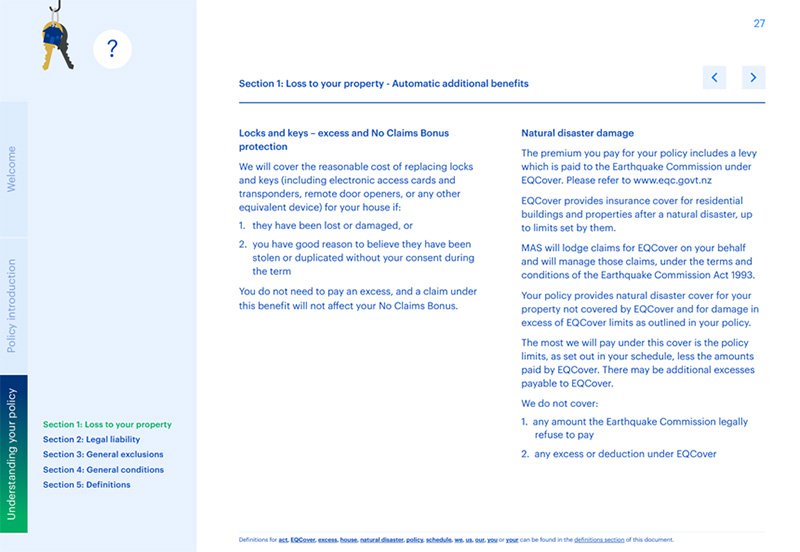
1. Changed the name of the “Natural Disaster Cover” benefit to “Natural Disaster Damage” and moved it to Section 1: loss to your property, Automatic additional benefits, page 27. As part of this change we have updated the benefit explanation to better reflect the way the benefit works under the policy and with EQC.
2. Clarified that the policy does not cover loss arising from a natural disaster other than the cover provided in the automatic additional benefits section of the policy for natural disaster damage.
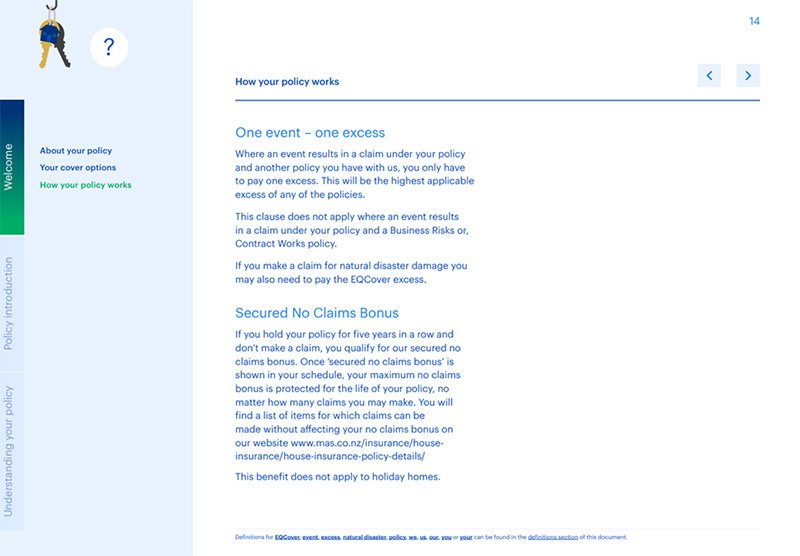
3. Updated the “one excess – one event” section of the policy, on page 14, to clarify that more than one excess may apply if the claim involves EQC cover (as separate EQC excesses may apply).
You can view the new House policy wording here.
Motor Vehicle policy document
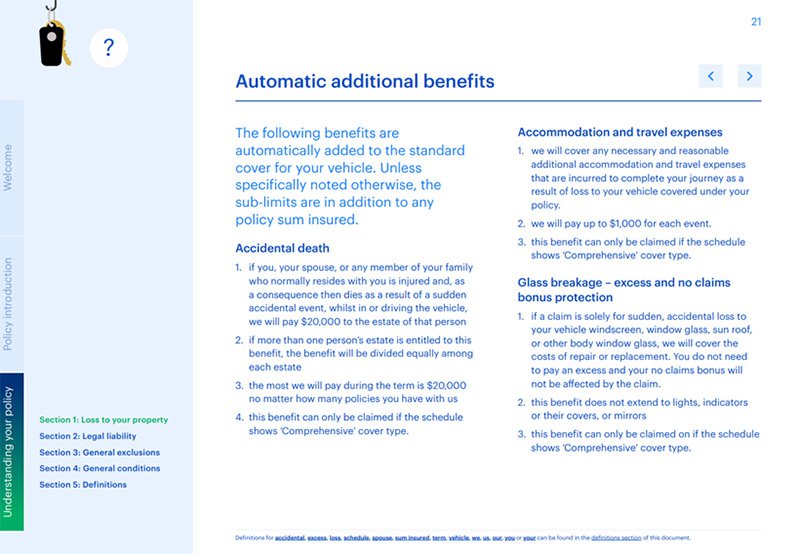
We have updated our Accidental Death benefit to better reflect how the benefit is intended to operate. This change means that the cover under this benefit now only applies when a sudden accidental event has occurred while the insured is ‘in or driving the vehicle’. You can find the new wording on page 21 of the Motor Vehicle policy document.
What do you need to do?
The new documents are provided to you on renewal. You will receive an email notifying you that your insurance is to be renewed and in this letter, there will be a link to your new policy document.
Until your policy comes up for renewal, you should continue to consult your existing policy documents.
We recommend you review your policies annually to ensure you have suitable cover and our support team can help with any questions you may have about your policy, including options to reduce your premiums. If you have any questions and would like to talk to a team member please call us on 0800 800 627.
The changes will be introduced to new policies and renewing policies from 28 March 2022 onwards and will apply to your policy when it comes up for its annual renewal.
If you would like to read the previous policy wordings, you can do so on our Insurance Resources page.
Corrections to multi-product and Goldshield discounts
We are making some corrections to the way we apply discounts for Members who hold more than one MAS general insurance policy.
Some Members have been receiving discounts for which they weren’t eligible, while other Members may have missed out on discounts they should have received in previous years. These corrections will come into effect when policies come up for their annual renewal.
If you are owed a discount, we will apply it to your policy and be in touch to confirm the refund you will be receiving for previous overpayments.
If you have been receiving a discount for which you weren’t eligible, we won’t ask for any repayment but we will remove the discount from the policy and adjust your next year’s premiums accordingly.
These corrections apply to the following discounts:
- Members are eligible for a multi-product discount if they hold two different MAS policies out of house, contents, or private motor vehicle insurance.
- Members are eligible for a Goldshield discount if they hold house, contents and motor vehicle insurance with MAS.
If you’re a personal Member and your policies are split between yourself and your partner, or your family trust, we’ll extend any eligible discount across the shared policies.
Changes to Motor Vehicle Premiums (effective from 8 September 2021)
We are making some changes to the premiums we charge for our motor vehicle policies. These changes will be introduced from 8 September, and will take effect when policies come up for their annual renewal.
- The 7.2% base premium discount offered due to COVID-19 lockdowns has expired. This was introduced in September 2020, to recognise the savings we had made on claims during the nationwide COVID lockdown due to cars being kept off the roads. You can read our original announcement about this discount here.
- As a mutual, we endeavour to keep premiums as low as possible, and motor vehicle premiums have not been changed for five years. We now need to reassess premiums to take account of changes in the motor vehicle industry and the rising costs of car parts due to COVID disruptions globally, along with the increasing sophistication of car parts generally.
These changes won’t affect all our policyholders in the same way but will instead take account of factors such as the location where the insured vehicle is usually parked and driven; the number of drivers named on the policy; and the make of the insured vehicle.
In general, these changes will result in premium increases for most of our policyholders, although the increases will be relatively modest. Around 70% of our policyholders will receive an increase of less than $100.
When considering your motor vehicle policy options, it is important to remember the benefits covered by your MAS premiums. These include:
- Free cover for windscreen damage if you have comprehensive motor vehicle insurance
- Automatic cover for trailers valued up to $2,000
- Accidental death cover up to $20,000
There are various ways to reduce your motor vehicle premiums, such as setting a higher voluntary excess for higher value vehicles, naming drivers on your policy, or restricting drivers of the vehicle to over-25-year-olds only.
We recommend you review your policies annually to ensure you have suitable cover for your vehicle, and our support team can help with any questions you may about your policy, including options to reduce your premiums.
You can make changes to your policy online using our Make a Change to a Motor Vehicle Policy form.
You can read the new policy wordings here:
MAS is introducing some changes to the wordings for our general insurance products – the group of insurance that covers things like house, car, and contents insurance, as well as business risk insurance.
Just as our Members buy insurance from MAS, MAS buys its own insurance from reinsurers.
Our reinsurers have changed their policy wordings for general insurance policies to more clearly exclude loss or damage connected with pandemics, cyber-attacks, and legal liability associated with asbestos.
We understand that because reinsurers are introducing these changes across the reinsurance market, it will impact other insurers as well as MAS.
The purpose of the changes is to make it clearer what is intended to be covered, and what is not covered, rather than to materially change the cover currently provided.
As a result, we expect it’s highly unlikely that MAS policyholders will be affected by these changes.
Our policies already excluded certain types of loss and damage relating to pandemics, cyber-attacks, and asbestos-related issues. We could not identify practical examples of Members who would be affected by the change.
The changes will be introduced to new policies and renewing policies from 1 July 2021 onwards, and will apply to your policy when it comes up for its annual renewal.
If you would like to read the previous policy wordings, you can do so on our Insurance Resources page.
More news
NZ HR Award winner "chuffed" with recognition
03 June 2022 - Abbigail Surridge has been named this year's Emerging HR Practitioner of the Year at the NZ HR Awards 2022.
Call for Nominations 2022
26 May 2022 - MAS is calling for nominations for the role of Practitioner Trustee of MAS Members’ Trust.